
Engineering the Legend: 10 Street-Legal Cars with Genuine Motorsport DNA
There is an unmistakable, raw electricity that defines a vehicle birthed from the crucible of professional racing. As an automotive engineer and enthusiast with over a decade of experience in the industry, I have observed that the most revered machines in history are not merely designed in a climate-controlled studio; they are forged in the white heat of competition. We aren’t simply discussing aggressive body kits or stiffened sway bars—we are talking about the heart of the machine: engines derived directly from race platforms.

When an automaker takes a power plant designed to endure the grueling 24 Hours of Le Mans or the high-stakes precision of Formula 1 and refines it for the public road, they aren’t just selling a car; they are offering a visceral, high-revving connection to history. In this deep dive, we explore 10 production vehicles that blur the lines between track performance and daily drivability.
Why Manufacturers Invest in Motorsport DNA
The “Win on Sunday, Sell on Monday” ethos remains the cornerstone of modern automotive excellence. Motorsport acts as a high-speed laboratory where physics is tested to its absolute limit. When an OEM invests millions into a race program, the goal is twofold: brand prestige and technological distillation. Components such as carbon-ceramic brakes, dual-clutch transmissions, and sophisticated active aerodynamics all have roots in professional racing.
Furthermore, integrating motorsport-derived engines into flagship models elevates the brand’s valuation. Consumers understand that when they purchase a car with a pedigree rooted in professional racing, they are buying an artifact of engineering excellence.
Alfa Romeo Montreal: The Tipo 33 Legacy
The Alfa Romeo Montreal remains an understated masterpiece. Beneath its sculpted hood lies a 2.6-liter V8 derived from the Tipo 33 endurance prototype. While the road-going iteration was tuned for civility, the spirit of the Targa Florio racer remains. It revs with a frantic, melodic energy that serves as a reminder of its lineage, proving that even a grand tourer can carry the soul of an Italian racer.
BMW M1, M5 (E28), and M6 (E24): The Inline-Six Revolution
BMW’s M division is the gold standard for high-performance engineering. The M88 inline-six, which debuted in the iconic BMW M1, was a direct descendant of BMW’s ProCar racing efforts. This engine architecture was so robust and versatile that it powered the E28 M5 and E24 M6, defining the brand’s reputation for precision. Even the legendary E30 M3, with its S14 engine, shared DNA with the M12 Formula 1 power plant, effectively democratizing touring car dominance for the average enthusiast.
Chevrolet Camaro ZL1 (1969): The Can-Am Terror
The 1969 Camaro ZL1 is perhaps the most visceral example of muscle car meets racetrack. Its 427-cubic-inch all-aluminum V8 was engineered specifically for the intensity of the Can-Am series. Producing 430 horsepower in its production trim, this engine was a lightweight, high-displacement titan. Owning a ZL1 today is akin to owning a piece of drag-racing royalty, as it represented a rare moment where a pure competition engine was tucked into a production chassis.
Ferrari Dino 206 GT: The Formula 2 Connection
Though it lacked the prancing horse badge, the Dino 206 GT was all Ferrari under the skin. Its 2.0-liter V6 was a direct evolution of Ferrari’s Formula 2 racing engine. Weighing in at roughly 2,000 pounds, the Dino utilized its race-derived heart to create an agile, mid-engine platform that influenced every sports car Ferrari produced thereafter.
Ferrari F50: F1 on the Freeway
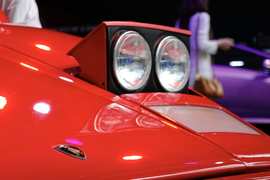
The Ferrari F50 stands as the ultimate tribute to the 1990 Tipo 641 Formula 1 car. Its 4.7-liter V12 is not just inspired by racing; it is, for all intents and purposes, a Formula 1 engine adapted for street use. With an 8,500 RPM redline, the F50 offers an unfiltered, auditory symphony that modern, turbocharged cars simply cannot replicate.
Ford GT (2005 & 2017): Le Mans DNA
The Ford GT story is one of endurance triumph. The 2005 model utilized a 5.4-liter supercharged V8 rooted in Ford’s Daytona Prototype programs. Meanwhile, the 2017 successor took a radical approach with a 3.5-liter twin-turbo EcoBoost V6—a direct descendant of the unit that propelled the Ford GT to a class victory at Le Mans. It represents the successful pivot from traditional displacement to forced-induction efficiency.
Jaguar XJ220: The Group C Survivor
Though originally intended to house a V12, the Jaguar XJ220 famously utilized a 3.5-liter twin-turbocharged V6 derived from the XJR-11 Group C race car. This decision created a technical marvel that pushed the XJ220 to a 217 mph top speed. It is a prime example of how professional racing performance can translate into a world-record-breaking production vehicle.
Plymouth Belvedere: The NASCAR Hemi
The 426 “Race Hemi” V8 is arguably the most recognizable engine in American automotive history. Developed specifically to dominate NASCAR, its presence in the Plymouth Belvedere transformed a humble family car into a high-performance legend. It didn’t just borrow racing tech; it brought the literal track engine to the local stoplight.
Porsche 918 Spyder: Hybrid Endurance
The 918 Spyder proves that hybridization is the future of motorsport. The 4.6-liter V8 at its core is a development of the engine used in the Porsche RS Spyder LMP2 car. When coupled with modern electric motors, the result is 887 horsepower and acceleration that challenges the limits of physics. It is the pinnacle of current automotive technology, blending high-CPC vehicle technology with track-proven reliability.
Porsche Carrera GT: The V10 Phenomenon
Before its production, the Carrera GT’s 5.7-liter V10 was shelved after a failed F1 program and a discontinued Le Mans prototype project. Porsche’s decision to resurrect this engine for a production supercar gave us one of the greatest mechanical experiences in history. The Carrera GT is raw, analog, and serves as a testament to the purity of a race-derived, naturally aspirated engine.
Future-Proofing Your Next Investment
As we move toward an era of electrification, the scarcity of these motorsport-derived internal combustion engines will only increase their market value. Whether you are looking for collector car investment opportunities or simply want to experience the thrill of a race-engineered powertrain, the current market offers diverse entry points.
If you are ready to explore the world of high-performance vehicles or want to understand how to maintain the legacy of these engineering marvels, now is the time to act. Contact our specialized consulting team today to discuss your next automotive acquisition or to learn more about the technical nuances of these track-bred legends. Your journey into the heart of motorsport excellence begins with a single step—reach out to us to schedule your private consultation.