
Engineering Excellence: 10 Legendary Production Cars with True Motorsport DNA
There is an electrifying aura surrounding a vehicle engineered with pure motorsport DNA. We aren’t merely discussing aesthetic race-inspired decals or subtle suspension tweaks; we are talking about high-performance machinery that hides authentic track-hardened engines beneath the hood. These power plants, forged in the crucible of elite competition, inject high-revving, adrenaline-drenched performance into the civilian driving experience, bridging the gap between professional circuit racing and the open road.
For over a decade, I have analyzed the intersection of automotive engineering and performance, and the “trickle-down” effect of racing technology remains the most fascinating aspect of the industry. In this deep dive, we explore 10 production vehicles that successfully blurred the lines between the paddock and the driveway. But first, we must examine why automotive giants invest billions into the unforgiving world of competitive racing and how that capitalizes on your daily driving satisfaction.
The Symbiosis of Track and Street
Motorsport serves as the ultimate laboratory. When engineers operate in an environment where failure is not an option—where milliseconds determine podium finishes—innovation accelerates at an exponential rate. Advanced aerodynamics, exotic lightweight materials, and thermodynamic efficiency are rarely birthed in a boardroom; they are refined under the stress of high-speed endurance.
Today, features we take for granted, such as paddle-shift transmissions, carbon-ceramic brakes, and active suspension, were once experimental prototypes tested at Le Mans or Monza. Furthermore, the “Win on Sunday, Sell on Monday” philosophy remains a pillar of brand equity. A victory in a prestigious racing series is the most effective marketing tool for a high-performance vehicle. When you pilot a car with a pedigree rooted in victory, you aren’t just driving; you are participating in a legacy.
Alfa Romeo Montreal: The Tipo 33 Legacy
The Alfa Romeo Montreal is a masterpiece of design, but its soul lies in its 2.6-liter naturally aspirated V8. Derived from the Tipo 33 sports prototype—a titan of endurance racing—this engine was designed to survive the Targa Florio and the 24 Hours of Daytona. While tempered for street legality, the Montreal engine retains a sharp, 7,000 RPM redline, offering a mechanical soundtrack that remains one of the most evocative in automotive history.
BMW M1, M5 (E28), and M6 (E24): The Inline-Six Mastery
BMW’s M division is synonymous with track precision. The iconic M88 3.5-liter inline-six engine, which powered the legendary M1 ProCar, serves as the cornerstone of this legacy. This engine architecture was later adapted for the E28 M5 and E24 M6, bringing high-revving, naturally aspirated power to the executive sedan market. Even the revered E30 M3’s S14 engine shares architectural DNA with the M12 F1 engine, proving that BMW’s touring car dominance was no accident.
Chevrolet Camaro ZL1 (1969): The Can-Am Titan
In the golden age of muscle, Chevrolet went to extremes. The 1969 Camaro ZL1 featured a 427-cubic-inch V8, essentially an all-aluminum masterpiece designed for Can-Am racing. While factory-rated at 430 horsepower for insurance reasons, these engines were true race-bred monsters. With only 69 units produced, this vehicle stands as a testament to the era when manufacturers were willing to put pure, unfiltered race equipment into showroom-ready shells.
Ferrari Dino 206 GT: The Formula 2 Pioneer
Before Ferrari solidified its mid-engine V8 dominance, there was the Dino. Its 2.0-liter V6 was developed directly for Ferrari’s Formula 2 program in the 1960s. Weighing just over 2,000 pounds, the Dino felt like a scaled-down Grand Prix car. It remains a vital study in how racing-derived weight distribution and engine placement can transform a street car’s handling dynamics.
Ferrari F50: F1 Performance for the Road
If you want to understand how deep the connection can go, look at the Ferrari F50. Its 4.7-liter V12 was fundamentally derived from the 1990 Ferrari 641 Formula 1 car. This isn’t just “inspired by” racing—it is a race engine with a muffler. Revving to 8,500 RPM, the F50 provides a raw, tactile experience that is nearly impossible to replicate in modern, safety-restricted supercars.
Ford GT (2005 & 2017): Honoring Le Mans
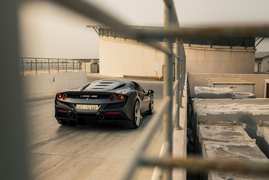
Ford has a storied history at Le Mans, and the Ford GT serves as the physical manifestation of that triumph. The 2005 model utilized a supercharged 5.4-liter V8 rooted in the Daytona Prototype engines, while the 2017 variant features a twin-turbocharged 3.5-liter EcoBoost V6—a direct descendant of the power units used in Ford’s grueling endurance campaigns. These vehicles prove that modern forced induction can be just as “race-authentic” as the displacement-heavy V8s of the past.
Jaguar XJ220: The Group C Survivor
The XJ220 is perhaps the most famous “what if” in supercar history. Intended for a V12, it ultimately arrived with a 3.5-liter twin-turbo V6 lifted directly from the XJR-11 Group C racer. This engine propelled the XJ220 to a record-breaking 217 mph, proving that a competition-derived mid-sized engine could eclipse the performance of larger, heavier counterparts.
Plymouth Belvedere: The Hemi Revolution
While synonymous with drag strips and NASCAR ovals, the 426 Hemi V8 in the 1964 Plymouth Belvedere brought track-only technology to the suburbs. The “Race Hemi” was designed for one purpose: total dominance on the banking. Offering 425 horsepower, it redefined what a production muscle car could achieve, essentially creating the template for the high-performance American V8 icons that followed.
Porsche 918 Spyder: The Hybrid Prototype
The Porsche 918 Spyder represents the pinnacle of modern hybrid engineering, but its heart is pure endurance racing. Its 4.6-liter V8 is an evolution of the RS Spyder LMP2 engine. By pairing this high-revving racing heart with advanced electric motors, Porsche achieved a 0-60 time of 2.2 seconds. It is the ultimate example of how hybrid architecture, when utilized for performance rather than just economy, pushes the boundaries of physical possibility.
Porsche Carrera GT: The F1 V10 Dream
Before it became an icon, the Carrera GT’s 5.7-liter V10 was an engine looking for a home, having been designed for a canceled Formula 1 and Le Mans project. Porsche’s decision to drop this race-ready unit into a road car created one of the most challenging and rewarding driving experiences ever manufactured. It remains the gold standard for analog supercar performance.
Investing in Automotive Heritage
Owning a vehicle with legitimate motorsport DNA is an investment in history. These machines represent the moments when manufacturers stopped compromising and allowed their racing engineering departments to influence the consumer market. Whether you are looking for the visceral scream of an F1-derived V10 or the raw torque of a NASCAR-bred V8, these cars are the closest most of us will ever get to the true spirit of racing.
As we look toward an electrified future, the value of these mechanical engineering marvels is only expected to climb. If you are an enthusiast looking to add a piece of racing history to your garage, now is the time to prioritize vehicles that offer documented competition provenance.
Are you ready to experience the difference between a mass-produced vehicle and a true race-bred machine? Explore our latest inventory of high-performance collector cars and discover the thrill of driving a vehicle designed for the track. Contact our team today to schedule an exclusive viewing or to discuss how you can secure your own piece of motorsport history.