
Unleashing the Track: 10 Production Cars with Pure Motorsport Engines
For a decade, I’ve witnessed firsthand how the relentless pursuit of speed and innovation on the racetrack fuels the evolution of the vehicles we drive every day. It’s more than just a sleek design or a performance package; it’s about the very heart of a car – its engine. Many of us dream of the visceral thrill of a true race car, the raw power, the high-revving symphony, and the absolute connection to the machine. What if I told you that you could experience a significant slice of that adrenaline-pumping excitement on public roads? This article delves into 10 production vehicles that don’t just look like they belong on the circuit, but are powered by engines originally conceived and honed in the crucible of motorsport. We’re talking about bona fide race-bred engines in production cars, bringing an unparalleled driving sensation to the street.
The allure of automotive racing DNA is undeniable. It’s a potent blend of engineering prowess, cutting-edge technology, and the ultimate test of man and machine. Automakers invest billions in motorsport for a multitude of reasons, and the benefits extend far beyond a trophy on a shelf. This strategic investment is a primary driver for technological advancements that eventually trickle down to the cars we purchase. From the aerodynamic efficiencies honed in wind tunnels and validated at speeds exceeding 200 mph, to the development of advanced composite materials that shave critical pounds, and crucially, the refinement of engine technology – racing acts as an unparalleled R&D laboratory. Think about it: disc brakes, paddle shifters, advanced traction control systems – these were all racing innovations that have become standard on modern vehicles.
Furthermore, the “Win on Sunday, Sell on Monday” mantra, a philosophy that experienced a golden age in decades past, is witnessing a significant resurgence. A manufacturer’s success in high-profile motorsport events, whether it’s Formula 1, Le Mans, or grueling rally stages, significantly bolsters brand prestige. This translates directly into a perception of superior engineering and desirability for their road-going counterparts. While few of us will ever pilot a Formula 1 machine or a Le Mans prototype, the presence of a race-inspired engine under the hood allows us to partake, at least vicariously, in the thrill of competition. It’s about feeling that direct link to the engineers and drivers who pushed the boundaries, all within the confines of a road-legal automobile.
The pursuit of performance vehicles with racing heritage isn’t merely about raw horsepower; it’s about a comprehensive approach to engineering that prioritizes responsiveness, durability under extreme stress, and an intoxicating driving experience. For enthusiasts and collectors, these vehicles represent more than just transportation; they are rolling pieces of automotive history, embodying the spirit of competition. The demand for such supercars with motorsport engines and track-focused road cars continues to grow, as discerning drivers seek out vehicles that offer an authentic connection to the world of professional racing.
Let’s explore these ten exceptional production vehicles that bring the thunder of the racetrack to your driveway, showcasing the very best of engines derived from motorsport competition.
Alfa Romeo Montreal: A V8 Symphony from the Targa Florio
The Alfa Romeo Montreal, a design masterpiece from the late 1960s and early 1970s, is often overlooked in discussions of iconic sports cars. However, beneath its stunning Bertone-designed exterior lies a powertrain with undeniable motorsport lineage. The Montreal is equipped with a 2.6-liter Tipo 33 V8 engine. This isn’t just any V8; it’s derived from the very heart of Alfa Romeo’s successful Tipo 33 sports prototype racers, which competed valiantly in grueling endurance events like the Targa Florio and the 24 Hours of Daytona.
While the road-going version was detuned for reliability and emissions compliance (compared to its track-bred sibling), the Montreal’s V8 still possessed a remarkable character. It could rev to a spirited 7,000 RPM, delivering a healthy 200 horsepower. This race-derived powerplant provided a distinctive, high-pitched exhaust note that was truly intoxicating – a symphony that few other cars of its era could replicate. Coupled with its sharp, aggressive styling, the Montreal offered a potent blend of Italian flair and genuine racing DNA, making it one of the most compelling and underrated Alfas ever produced. For those seeking vintage sports cars with racing engines, the Montreal is a compelling proposition.
BMW M1, M3 (E30), M5 (E28), M6 (E24): The Motorsport Division’s Genesis
BMW’s M division is synonymous with performance, and its early models are deeply intertwined with motorsport. The legendary BMW M1, a mid-engined supercar from the late 1970s, was powered by the M88 3.5-liter inline-six engine. This powerplant was a direct descendant of BMW’s racing engine programs, most notably finding its application in the highly competitive BMW M1 ProCar series. This engine’s prowess wasn’t confined to the M1; it later found its way into the iconic E24 M6 and the E28 M5, solidifying its reputation as a robust and powerful unit.
Even more remarkable is the lineage of the E30 M3’s four-cylinder S14 engine. While smaller in displacement at 2.3 liters, it was heavily inspired by, and shared engineering principles with, the formidable M88 and the turbocharged M12 Formula 1 engines. This engine was conceived with touring car racing in mind, sharing components and design philosophies with the cars that dominated the German Touring Car Championship (DTM). The E30 M3, with its track-honed chassis and its potent, rev-happy engine, became an instant legend, embodying the “Win on Sunday, Sell on Monday” ethos. These BMW M cars are prime examples of performance sedans with race-bred engines and track-inspired sports cars that delivered unparalleled driving dynamics for their time.
Chevrolet Camaro ZL1 (1969): A Can-Am Beast Unleashed

The 1969 Chevrolet Camaro ZL1 is a nameplate that still sends shivers down the spines of muscle car and motorsport enthusiasts alike. What set this Camaro apart was its heart: the legendary 427 cubic-inch (7.0-liter) V8 engine. This wasn’t a standard production V8; it was a full-blown racing engine originally designed for the brutal world of Can-Am (Canadian-American Challenge Cup) racing. Constructed entirely from aluminum, it was remarkably light for its immense displacement and power output.
While this race engine was capable of producing around 500 horsepower in its pure racing form, Chevrolet strategically detuned it to a still formidable 430 horsepower for the road-going ZL1 to meet street-legal requirements. Even with this adjustment, the ZL1 package transformed the Camaro into a veritable street-legal drag strip monster. Its race-bred engine also found its way into various race cars competing in the SCCA Trans-Am series. With only 69 examples ever produced, the 1969 Camaro ZL1 is an incredibly rare and highly coveted collector’s item, representing one of the most extreme examples of a V8 race engine in a production car. For collectors seeking American muscle cars with racing engines, the ZL1 is the pinnacle.
Ferrari Dino 206 GT: The Birth of a Mid-Engined Icon
While it didn’t wear the iconic Prancing Horse badge, the Ferrari Dino 206 GT, introduced in the late 1960s, holds a significant place in Ferrari’s history and its connection to motorsport. Its powerplant was a 2.0-liter Dino V6 engine, a unit originally developed by Ferrari for their Formula 2 racing endeavors in the 1960s. This engine was designed to be lightweight, compact, and capable of high revs, all crucial attributes for competitive circuit racing.
Even after being adapted for road use in the Dino 206 GT, the V6 engine retained its spirited, high-revving nature. This characteristic lent the Dino a palpable racing spirit, making it an absolute joy to drive on winding roads and spirited sprints. Producing 180 horsepower, it was more than adequate for a car that tipped the scales at just over 2,000 pounds. The Dino 206 GT marked Ferrari’s initial foray into mid-engined V6 sports cars, setting a crucial precedent for future, more powerful models that would ultimately carry the full Ferrari emblem. It stands as an early testament to the value of F2-derived engines in road cars.
Ferrari F50: Formula 1 on the Streets
The Ferrari F50, conceived to commemorate the Italian marque’s 50th anniversary, represents an almost unprecedented commitment to bringing a Formula 1 engine directly to a production car. Its beating heart is a 4.7-liter Tipo F130B naturally aspirated V12 engine, a powerplant that was derived directly from Ferrari’s formidable Formula 1 car of 1990, the Tipo 641 (later known as the F1-90), famously piloted by Alain Prost.
This naturally aspirated V12 was a high-revving monster, capable of spinning to an ear-splitting 8,500 RPM and unleashing a staggering 513 horsepower. The F50 offered a driving experience that was astonishingly close to that of a true F1 car, with raw, unfiltered feedback and an incredible sonic assault. With only minimal modifications to meet road-going regulations, the F50 stands as one of the purest expressions of Formula 1 engine technology in a street-legal car. For enthusiasts seeking the ultimate track-inspired supercar experience, the F50 remains a benchmark.
Ford GT (2005 & 2017): A Modern Homage to Racing Legends
The Ford GT is a modern-day supercar explicitly designed as an homage to one of the most legendary race cars in automotive history: the Le Mans-winning Ford GT40. Both generations of the Ford GT showcase engines with deep roots in motorsport development, reinforcing the brand’s enduring racing legacy.
The first-generation Ford GT, produced in 2005, featured a 5.4-liter supercharged V8. This engine drew heavily from Ford’s extensive experience in endurance racing, sharing development pathways with the powerplants used in Ford’s Daytona Prototype race cars.
The more recent 2017 Ford GT boasts even more direct motorsport connections. It is powered by a twin-turbocharged 3.5-liter EcoBoost V6 engine. This engine is a highly evolved derivative of Ford’s successful EcoBoost program, which has seen significant competition and triumph in endurance racing series like IMSA. The GT’s twin-turbo V6 delivers exceptional performance, showcasing the effectiveness of EcoBoost technology in performance road cars and endurance racing-derived engines. These Fords are prime examples of modern supercars with racing DNA.
Jaguar XJ220: A Le Mans Prototype for the Road
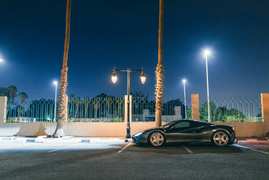
The Jaguar XJ220, a sleek and futuristic supercar from the early 1990s, is a celebrated icon of British automotive engineering, albeit with a fascinating powertrain twist. While initially envisioned with a V12 engine, the production version of the XJ220 ultimately featured a potent 3.5-liter twin-turbocharged V6. This wasn’t just any V6; it was sourced directly from Jaguar’s successful XJR-11 Group C race car.
This competition-derived engine was a technological marvel for its time, enabling the XJ220 to achieve a mind-bending top speed of 217 mph, crowning it the fastest production car in the world for a brief but glorious period. The XJ220’s engine represented a significant achievement in bringing advanced Group C racing technology to road-going vehicles. It remains one of the most potent and track-proven engines to ever grace a production automobile, offering a visceral connection to Jaguar’s formidable racing heritage. For those seeking fastest production cars with racing engines, the XJ220 is a standout.
Plymouth Belvedere (1964): The Mighty Hemi’s Genesis
At first glance, the 1964 Plymouth Belvedere might appear to be a quintessential American muscle car. However, beneath its muscular hood lay an engine that was forged in the fires of competitive racing: the legendary 426 Hemi V8. This engine was specifically developed for the demanding environment of NASCAR.
Known affectionately as the “Race Hemi,” this powerplant was an absolute dominant force on the racetrack. Its sheer power and relentless performance soon led to its inclusion in Plymouth’s production lineup, albeit with some modifications for street use. The road-going version of the Belvedere, churning out an impressive 425 horsepower, quickly became one of the most formidable and desirable muscle cars of the 1960s. This engine’s legacy continued, forming the basis for the iconic ‘Cuda that would define Mopar performance through the ’70s. The Belvedere is a prime example of NASCAR engine technology in a production car, defining the era of powerful V8 muscle cars.
Porsche 918 Spyder: Hybrid Hypercar with a Racing Heart
The Porsche 918 Spyder, a groundbreaking hybrid hypercar, showcases a remarkable fusion of electric power and pure motorsport prowess. Its core powerplant is a 4.6-liter naturally aspirated V8 engine. This V8 is not a bespoke design for the 918; rather, it is based on the highly successful RS Spyder, a prototype race car that competed fiercely in the LMP2 class at the grueling 24 Hours of Le Mans.
When combined with its advanced electric motors, this race-derived V8 propelled the 918 Spyder to a combined output of a staggering 887 horsepower. This allowed it to achieve blistering acceleration, famously rocketing from 0 to 60 mph in just 2.2 seconds (according to independent testing), positioning it among the quickest production cars ever made. While the electric motors contribute significantly to its astonishing performance, it is the visceral thrill and the intoxicating auditory experience provided by the race-derived V8 engine that truly captivates the driver. The 918 Spyder represents the pinnacle of hybrid hypercars with motorsport engines.
Porsche Carrera GT: The Analog Supercar’s V10 Soul
The Porsche Carrera GT is widely regarded as one of the greatest analog supercars ever conceived, and a significant portion of its legendary status can be attributed to its extraordinary 10-cylinder engine. This 5.7-liter V10 powerplant has a fascinating backstory steeped in motorsport ambition. It was originally developed by Porsche with aspirations for Formula 1 during the V10 engine era.
When that particular F1 project didn’t materialize, the engine was shelved. However, its potential was too great to be ignored. It was later repurposed for a Le Mans prototype car, though this car never ultimately saw competitive track action. Instead of letting such a potent engine go to waste, Porsche ingeniously decided to deploy it in their flagship supercar. This race-honed engine enabled the Carrera GT to produce an exhilarating 612 horsepower and rev all the way to a screaming 8,000 RPM. Combined with its lightweight construction and purebred motorsport DNA, the Carrera GT remains a challenging yet incredibly rewarding driving machine, a true testament to V10 engines from racing development in supercars. For those who appreciate pure driving engagement and motorsport legacy, the Carrera GT is an unparalleled choice.
These ten vehicles, each with its unique story and technical brilliance, offer a compelling glimpse into the symbiotic relationship between motorsport and the automotive industry. They demonstrate that the pursuit of racing excellence doesn’t just benefit the few on the podium, but enriches the driving experience for enthusiasts worldwide.
If you’re captivated by the thrill of these race-bred machines and are seeking to explore your own performance car options with motorsport DNA, we invite you to connect with our team of specialists. Let us help you find the perfect vehicle that embodies the spirit of the track and delivers an unforgettable driving adventure.