
From Track to Tarmac: 10 Production Cars That Roar with Motorsport DNA
The visceral thrill of a car with genuine motorsport DNA coursing through its veins is an experience unlike any other. It’s not merely about aesthetics or minor performance upgrades; it’s about the potent heart beating beneath the hood – an engine born from the crucible of intense competition, now offering its high-revving, adrenaline-fueled character to public roads. These machines serve as a direct, tangible link to the racing machines that inspired their very creation, blurring the lines between the spectator stands and the driver’s seat.
In this deep dive, we’ll explore ten production vehicles that masterfully bridge the gap between the racetrack and your daily commute. From the operatic wail of naturally aspirated V12s to the brutal efficiency of turbocharged behemoths, these cars deliver an unfiltered taste of pure motorsport performance to the everyday driver. But before we unleash this list, let’s consider the profound strategic and engineering reasons why automotive manufacturers invest heavily in the demanding world of motorsport, and how that investment directly influences the vehicles available to the discerning consumer. Understanding this symbiotic relationship is key to appreciating the pedigree behind these exceptional automobiles.
The Symbiotic Dance: Motorsport and Road Cars
The intricate relationship between motorsport and production vehicles is as old as the automobile itself. The racetrack serves as the ultimate proving ground, a relentless testing environment that pushes the absolute limits of engineering. Here, components are subjected to extreme stresses, where failure is not an option, and innovation is a necessity for survival and victory. The hard-won lessons, the breakthroughs in material science, the refinements in aerodynamics, and, crucially, the advancements in powertrain technology – all forged in the heat of competition – invariably find their way into the cars we drive every day. Technologies like disc brakes, sophisticated electronic fuel injection, and even the ubiquitous paddle shifters, once the exclusive domain of racing circuits, are now standard features on a vast array of production cars.

Beyond the technical advantages, motorsport success acts as an unparalleled catalyst for brand enhancement. When a manufacturer’s race car dominates its respective series, it imbues its entire product line with an aura of performance, desirability, and engineering prowess. While the average enthusiast may never experience the raw G-forces of a Formula 1 car or the endurance-testing demands of a Le Mans prototype, the presence of a race-bred engine in a production vehicle allows for a profound connection to that world of high-stakes competition. It’s a shared legacy, a palpable sense of being part of something bigger, especially when that distinctive engine note emanates from beneath your own hood. This “Win on Sunday, Sell on Monday” ethos, once a cornerstone of automotive marketing, is experiencing a powerful resurgence, signaling a golden era for the car industry where factory involvement in racing translates directly to enhanced consumer products.
A Legacy of Speed: Ten Production Cars with True Motorsport Heart
Let’s embark on a journey through ten exceptional production vehicles that proudly showcase their racing lineage, offering a driving experience that echoes the thrill of the track:
Alfa Romeo Montreal: The V8 Heart of a Racer
The Alfa Romeo Montreal, a captivating piece of Italian design from the late 1960s and early 1970s, houses a gem of an engine: a 2.6-liter Tipo 33 naturally aspirated V8. This powerplant was directly derived from Alfa Romeo’s formidable Tipo 33 sports prototype, a dedicated endurance racer that competed with distinction in legendary events like the Targa Florio and the 24 Hours of Daytona. While meticulously detuned for the rigors of road use, the engine in the Montreal retained a significant portion of its motorsport character. It enthusiastically revs to an impressive 7,000 RPM, delivering a robust 200 horsepower. The distinctive, sonorous roar of its V8, combined with its sharp, distinctive styling, cemented the Montreal’s status as one of the most compelling and criminally underrated cars to ever bear the Alfa Romeo badge. Its performance credentials, rooted in a genuine racing pedigree, make it a standout example of motorsport DNA filtering down to production cars.
BMW M1, M3 (E30), M5 (E28), M6 (E24): The M Division’s Motorsport Vanguard
BMW’s M division is synonymous with performance, and the brand’s racing heritage is indelibly etched into its most iconic models. The BMW M1, a mid-engined sports car produced in limited numbers during the late 1970s and early 1980s, is a prime example. It was powered by the legendary 3.5-liter inline-six M88 engine, a powerplant with direct roots in BMW’s motorsport programs, most notably finding a home in the purpose-built BMW M1 ProCar series. This formidable engine later found its way into the esteemed E24 M6 and E28 M5, imbuing these luxury sedans and coupes with supercar-rivaling performance.
Furthermore, the four-cylinder S14 engine that powered the legendary E30 M3 was itself heavily inspired by the M88 and the turbocharged M12 Formula 1 engines. This engine was a direct beneficiary of BMW’s extensive touring car racing endeavors, sharing critical components and engineering principles with the cars that dominated the Deutsche Tourenwagen Masters (DTM) series. The M3, in particular, became a homologation special, requiring its production to meet racing regulations, thereby ensuring its road-going iteration carried genuine race-bred DNA. The consistent application of motorsport principles across these foundational M cars underscores BMW’s unwavering commitment to performance.
Chevrolet Camaro ZL1 (1969): A Can-Am Beast Unleashed
The 1969 Chevrolet Camaro ZL1 stands as a monumental testament to American muscle car performance, largely due to its extraordinary engine: a 427 cubic-inch (7.0-liter) all-aluminum V8. This powerhouse was originally conceived and engineered for the demanding world of Can-Am (Canadian-American Challenge Cup) racing. Its all-aluminum construction was a significant engineering feat, allowing for a relatively lightweight engine given its immense displacement. While factory-rated at a potent 430 horsepower for road use, this engine was capable of producing closer to 500 horsepower in its race-tuned configuration. The ZL1 package transformed the Camaro into a legitimate street-legal drag strip terror. Its race-bred engine was so potent that it continued to power numerous race cars competing in the highly competitive SCCA Trans-Am series. With only 69 units ever produced, the 1969 Camaro ZL1 is an exceptionally rare and highly coveted collector’s item today, representing a pivotal moment where pure racing hardware was offered to the public.
Ferrari Dino 206 GT: The Birth of a Mid-Engined Legend
The Ferrari Dino 206 GT, a slightly more accessible and often misunderstood offering from the legendary Italian marque, harbored a sophisticated 2.0-liter naturally aspirated V6 engine. This compact yet potent powerplant was originally developed for Ferrari’s Formula 2 racing efforts during the 1960s. Although recalibrated for road use, the engine’s inherent high-revving nature and its racing origins lent the Dino a distinct sporting spirit, making it an absolute joy to drive on winding country roads. Producing a respectable 180 horsepower, this was more than adequate for a car weighing just over 2,000 pounds, contributing to its agile handling and exhilarating acceleration. Significantly, the Dino was one of the few Ferrari-branded vehicles that did not bear the iconic Prancing Horse emblem on its exterior, a decision made at the time to differentiate it from the V12-powered flagship models. Nevertheless, it marked Ferrari’s crucial first foray into mid-engined V6 sports cars, setting a vital precedent for many future, highly successful models that would follow. The Dino’s racing-derived V6 is a clear indicator of motorsport influencing even the more accessible segments of Ferrari’s production.
Ferrari F50: Formula 1 on the Street
To commemorate its 50th anniversary, Ferrari didn’t just build a special car; it engineered a road-legal Formula 1 experience. The Ferrari F50 represents a monumental leap in bringing track technology to the street. Its heart is a breathtaking 4.7-liter naturally aspirated V12, designated Tipo F130B, which was directly liberated from Ferrari’s 1990 Formula 1 challenger, the Tipo 641 – the very car piloted by the legendary Alain Prost. This naturally aspirated masterpiece is capable of screaming to an astonishing 8,500 RPM, unleashing a formidable 513 horsepower. The F50 delivers an unfiltered, raw sensory experience that is as close as one could get to driving an actual F1 car on public roads at the time. With only minimal modifications necessary to meet road-going regulations, the F50’s engine provided an unparalleled connection to the pinnacle of motorsport. Its visceral performance and sound are a direct inheritance from the grand prix circuits, making it a truly extraordinary machine.
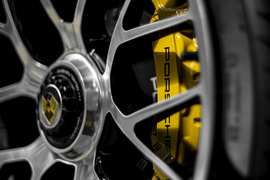
Ford GT (2005 & 2017): A Homage to Endurance Racing Dominance
The Ford GT is far more than just a modern supercar; it’s a profound homage to one of the most legendary race cars in automotive history: the Le Mans-winning Ford GT40. The 2005 iteration of the GT featured a robust 5.4-liter supercharged V8 engine. Its development was deeply intertwined with Ford’s endurance racing programs, bearing a close relation to the powerplants used in Ford’s Daytona Prototype race cars. This lineage provided the 2005 GT with an authentic motorsports foundation, delivering 550 horsepower and 500 lb-ft of torque.
The newer, 2017 Ford GT continues this rich tradition of motorsport integration, albeit with a different configuration. It boasts a twin-turbocharged 3.5-liter EcoBoost V6 engine, directly derived from Ford’s highly successful EcoBoost program that has seen extensive application in endurance racing, including multiple victories at the 24 Hours of Le Mans. This advanced V6 powerplant produces a stunning 647 horsepower and 550 lb-ft of torque, proving that cutting-edge engine technology developed for the track can translate into world-beating road car performance. Both generations of the Ford GT are clear manifestations of Ford’s enduring commitment to racing and its ability to translate that passion into exceptional production vehicles.
Jaguar XJ220: The Twin-Turbo V6 Velocity King
The Jaguar XJ220, a car that captivated the automotive world with its futuristic styling and astonishing performance, is a prime example of race-bred engineering making its way into a production supercar. While initially envisioned with a V12 engine, the XJ220 ultimately adopted a potent 3.5-liter twin-turbocharged V6 engine. This powerplant was not just any V6; it was derived directly from the Jaguar XJR-11, a formidable Group C race car that competed in the brutal World Sportscar Championship. This competition-proven engine was the key to the XJ220’s mind-bending performance. It propelled the car to an astonishing top speed of 217 mph, a figure that, for a period, made it the fastest production car in the world. The XJ220’s engine represented one of the most advanced and track-honed powertrains ever fitted into a road-going vehicle, showcasing the direct benefits of a rigorous racing development cycle.
Plymouth Belvedere (1964): The “Race Hemi” Muscle Icon
At first glance, a 1964 Plymouth Belvedere might not immediately strike one as a car with deep motorsport roots. However, lurking beneath its muscular hood was the legendary 426 Hemi V8, an engine engineered specifically for the demanding arena of NASCAR racing. Known affectionately as the “Race Hemi,” this engine was an absolute dominant force on the stock car circuit. Its overwhelming success and power quickly led to its integration into Plymouth’s production car lineup. The road-going version of the Belvedere, equipped with this potent V8, produced a formidable 425 horsepower. This made it one of the most powerful and sought-after muscle cars of the 1960s, a reputation that continued through the 1970s with the iconic ‘Cuda model. The Belvedere is a quintessential example of how engines designed for the brutal world of professional racing could fundamentally redefine the performance landscape for consumer vehicles.
Porsche 918 Spyder: Hybrid Hypercar with a Racing Heart
The Porsche 918 Spyder stands as a remarkable achievement in automotive engineering, seamlessly blending hybrid technology with a purebred racing engine. Its 4.6-liter naturally aspirated V8 engine was directly based on the design of the RS Spyder, a highly successful prototype race car that competed in the LMP2 class at the prestigious 24 Hours of Le Mans. This competition-derived V8, when combined with its advanced electric motors, unlocked astonishing performance. The 918 Spyder produced a combined output of 887 horsepower, enabling it to accelerate from 0 to 60 mph in a blistering 2.2 seconds, according to independent testing, making it one of the quickest production cars ever created. While the electric motors undeniably contribute to its blistering acceleration and efficiency, it is the race-derived V8 that provides the car with its visceral character, its soul-stirring auditory experience, and that undeniable emotional connection to motorsport. The 918 Spyder exemplifies how cutting-edge hybrid powertrains can be augmented by the raw character of race-proven internal combustion engines.
Porsche Carrera GT: The Analog Supercar Symphony
Often lauded as one of the greatest analog supercars ever conceived, the Porsche Carrera GT owes a significant portion of its legendary status to its extraordinary powerplant: a naturally aspirated 5.7-liter V10 engine. This magnificent V10 was originally developed with the intention of competing in Formula 1 during the sport’s V10 era. However, when those plans didn’t materialize, the engine was shelved. It later found a second life in a Le Mans prototype program that, unfortunately, never reached the racetrack. Instead of letting this potent race-built engine go to waste, Porsche made the inspired decision to integrate it into its flagship supercar. This allowed the Carrera GT to produce a staggering 612 horsepower and rev with thrilling abandon all the way to 8,000 RPM. Coupled with its feather-light construction and unadulterated motorsport DNA, the Carrera GT remains one of the most challenging and rewarding supercars to drive, a true purist’s machine that connects the driver directly to the raw essence of racing.
Experience the Legacy: Your Next Step
These ten vehicles are more than just modes of transportation; they are rolling testaments to the relentless pursuit of performance, engineering excellence, and the enduring allure of motorsport. They represent a tangible connection to the world of competitive racing, offering an experience that transcends mere driving.

If the idea of owning a piece of automotive history, a car that carries the very spirit of the racetrack, ignites your passion, then it’s time to explore further. Whether you dream of the symphony of a V12, the raw power of a V8, or the precise engineering of a turbocharged marvel, the world of motorsport-derived production cars awaits. We encourage you to delve deeper into the specific models that have captured your imagination, research their unique histories, and perhaps, if the opportunity arises, experience the thrill of driving one for yourself. Your journey into the heart of motorsport performance on the road starts now.