
Unleashing the Roar: 10 Production Cars Born from the Racetrack
For over a decade, I’ve been immersed in the exhilarating world of automotive performance, witnessing firsthand the profound impact motorsport has on the vehicles gracing our public roads. It’s a connection that transcends mere aesthetics or superficial performance upgrades. We’re talking about machines that carry genuine motorsport DNA, housing engines meticulously engineered and proven in the crucible of competitive racing. These powerhouses, forged in the heat of intense competition, deliver a visceral, high-revving, adrenaline-fueled experience that directly links the driver to the very race cars that inspired their creation.
In this exploration, we delve into ten production vehicles that masterfully blur the lines between the racetrack and the street. From the spine-tingling wail of V12s to the brute force of turbocharged titans, these ten production vehicles offer a tangible taste of racing prowess accessible to everyday enthusiasts. But before we celebrate these automotive marvels, let’s unpack the strategic rationale behind manufacturers investing heavily in the demanding arena of motorsport and examine how these investments trickle down to the cars we can actually own and drive.
The Symbiotic Relationship: Motorsport’s Influence on Road-Going Vehicles
The intrinsic link between motorsport and road cars is undeniable and has been a driving force in automotive evolution for decades. Racing serves as an extreme proving ground, pushing the boundaries of engineering and subjecting vehicles and their components to immense stresses where even minor failures are unacceptable. The invaluable lessons learned on the track – be it advancements in aerodynamic efficiency, the strategic use of lightweight materials, or groundbreaking engine technologies – invariably find their way into the cars we drive daily. This relentless pursuit of performance through racing effectively lays the foundation for superior road cars.
Consider the ubiquitous nature of disc brakes and paddle shifters; both were innovations born from the demands of racing before becoming standard features in production vehicles. Furthermore, success on the racetrack often serves as a powerful catalyst for enhancing a manufacturer’s brand image. When a company’s race car achieves dominance on the track, its road-going counterparts are perceived as inherently more desirable and capable. While the dream of owning a Formula 1 car or a Le Mans prototype remains out of reach for most, the thrill of being connected to motorsport’s excitement is very much achievable, especially when a genuine race-bred engine throbs beneath the hood of your production car. This “Win on Sunday, Sell on Monday” philosophy is experiencing a significant renaissance, and it’s arguably the most positive development for the automotive industry in recent memory, signaling a resurgence in OEM participation in motorsport.
Ten Production Cars Infused with Racing Prowess
Let’s examine some of the most compelling examples of this motorsport trickle-down:
Alfa Romeo Montreal
The Alfa Romeo Montreal is a captivating machine, its striking design complemented by an engine that whispers tales of its racing lineage. Beneath its sculpted hood resides a 2.6-liter V8 engine, a direct descendant of Alfa Romeo’s formidable Tipo 33 sports prototype. This endurance racer competed in prestigious events like the Targa Florio and the 24 Hours of Daytona, renowned for its robust performance. While meticulously detuned for civilian duty, the Montreal’s V8 retains a significant portion of its motorsport character. It eagerly spins to 7,000 RPM, producing a spirited 200 horsepower. The intoxicating symphony of its V8, coupled with its sharp, unmistakable styling, cemented the Montreal’s status as one of the most stylish and criminally underrated cars to ever wear the Alfa Romeo emblem. This legendary Italian marque is renowned for its rich history and fascinating facts that often surprise even devoted enthusiasts.
BMW M1, M3 (E30), M5 (E28), M6 (E24)
BMW’s commitment to motorsport is deeply etched into the DNA of its most iconic M models. The BMW M1, a mid-engined marvel, was powered by the legendary 3.5-liter inline-six M88 engine. This powerplant was a direct result of BMW’s intensive racing programs, notably serving in the fiercely competitive BMW M1 ProCar series. This same potent engine later found its way into the formidable E24 M6 and the E28 M5, lending them exceptional performance. Even the four-cylinder S14 engine that propelled the legendary E30 M3 owed its existence to the M88 and the turbocharged M12 Formula 1 engines. This strategic engineering approach ensured that the E30 M3 shared vital components and innovative engineering with the touring cars that consistently dominated the Deutsche Tourenwagen Masters (DTM) racing circuit. Celebrating 50 Years of Amazing BMW M Cars highlights the brand’s unwavering dedication to performance and racing heritage.
Chevrolet Camaro ZL1 (1969)
The 1969 Chevrolet Camaro ZL1 stands as a testament to American muscle car engineering with genuine racing credentials. It featured a colossal 427 cubic-inch (7.0-liter) V8 engine, originally conceived for the demanding Can-Am racing series. Its all-aluminum construction made it remarkably light for its displacement, unlocking astonishing power potential. While factory-rated at a conservative 430 horsepower for street use, this potent mill was capable of producing closer to 500 horsepower in its true racing configuration. The ZL1 package transformed the Camaro from a stylish coupe into a bona fide street-legal drag strip terror. Its engine’s prowess extended beyond the showroom, finding a home in numerous race cars that competed in the SCCA Trans-Am series. With only 69 examples ever produced, the 1969 Camaro ZL1 remains an exceptionally rare and highly coveted collector’s item, representing a pinnacle of American muscle car performance derived from racing.
Ferrari Dino 206 GT
The Ferrari Dino 206 GT, while not bearing the iconic Prancing Horse badge initially, harbored an engine with clear racing origins. Its 2.0-liter V6 engine was initially developed for Ferrari’s Formula 2 racing endeavors in the 1960s. Though de-tuned for road use, this powerplant retained its exhilarating high-revving character, imbuing the Dino with a palpable racing spirit that made it an absolute joy to drive on winding country roads. Producing a lively 180 horsepower, it was more than sufficient for a car that tipped the scales at just over 2,000 pounds. The Dino marked a significant departure for Ferrari, representing their inaugural foray into mid-engined V6 sports cars, and setting a precedent for many future models, demonstrating the brand’s commitment to innovative powertrain development.
Ferrari F50
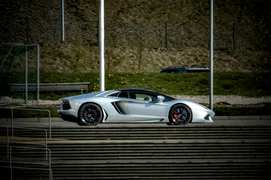
The Ferrari F50 represents an audacious leap in bringing Formula 1 technology to the road. Conceived to commemorate the Italian marque’s 50th anniversary, the F50 doesn’t merely hint at its racing pedigree; it practically screams it. Its heart is a 4.7-liter naturally aspirated V12, the Tipo F130B, derived directly from Ferrari’s 1990 Formula 1 car, the Tipo 641 – famously piloted by the legendary Alain Prost. This naturally aspirated behemoth shrieks to an astonishing 8,500 RPM, unleashing a formidable 513 horsepower. It delivers the raw, unadulterated sensation of an F1 car for the street. With only minimal modifications required to meet road-legal regulations, the F50 offered the closest possible experience to driving a Formula 1 car on public roads at the time. Discovering 10 Facts About Ferrari You Probably Didn’t Know often reveals the depth of their racing heritage.
Ford GT (2005 & 2017)
The Ford GT is a living homage to one of the most storied race cars in history: the Le Mans-conquering Ford GT40. The 2005 iteration of the GT featured a potent 5.4-liter supercharged V8 engine, whose roots were deeply embedded in the development of Ford’s endurance racing powertrains, sharing kinship with the engines powering Ford’s Daytona Prototype race cars. Mirroring this commitment to motorsport, the more contemporary 2017 Ford GT boasts equally impressive performance credentials, powered by a twin-turbocharged 3.5-liter V6. This engine originates from Ford’s highly successful EcoBoost program, which has seen extensive application in endurance racing. The development of the Ford GT was an unplanned happy accident, originally conceived with a different platform in mind, underscoring the organic evolution of performance vehicles.
Jaguar XJ220
The Jaguar XJ220 remains an iconic masterpiece from the esteemed British marque. While initially envisioned with a V12 engine, it ultimately housed a more potent 3.5-liter twin-turbocharged V6, directly sourced from the Jaguar XJR-11 Group C race car. This competition-derived powerhouse propelled the XJ220 to a blistering top speed of 217 mph, momentarily crowning it the fastest production car in the world. The XJ220’s engine stands as a prime example of cutting-edge, track-proven technology making its way into a road-going supercar, offering an unparalleled supercar driving experience. Recent developments suggest Jaguar Land Rover Ready to Make Huge Departure From Previous Models, signaling a new era for the brand.
Plymouth Belvedere (1964)
At first glance, the 1964 Plymouth Belvedere might not immediately conjure images of a race car. However, beneath its unassuming exterior lay the legendary 426 Hemi V8, an engine specifically engineered for the grueling demands of NASCAR. Dubbed the “Race Hemi,” this powerplant was a dominant force on the racetrack and soon became a celebrated option in Plymouth’s production lineup. The Belvedere equipped with this engine, producing a mighty 425 horsepower, quickly established itself as one of the most powerful muscle cars of the 1960s – a reputation the brand skillfully carried into the 1970s with its iconic ‘Cuda. Understanding Everything You Need to Know About NASCAR provides context for the engineering feats required in such racing disciplines.
Porsche 918 Spyder
The Porsche 918 Spyder is a hypercar that seamlessly integrates cutting-edge hybrid technology with a race-derived internal combustion engine. Its 4.6-liter V8 powerplant is based on the RS Spyder, a formidable prototype race car that competed in the LMP2 class at the prestigious 24 Hours of Le Mans. The 918 ingeniously combines this competition-honed V8 with electric motors to deliver a staggering combined output of 887 horsepower. This allows it to achieve breathtaking acceleration, reaching 60 mph in a mere 2.2 seconds (according to independent testing), making it one of the quickest production cars ever built. While the electric motors contribute significantly to its electrifying performance, it is the race-derived V8 that provides the car’s intoxicating emotional engagement and aural symphony. Porsche continues to push boundaries, with speculation about a potential 918 Spyder successor hinting at future innovation.
Porsche Carrera GT
The Porsche Carrera GT is widely revered as one of the greatest analog supercars ever produced, and a significant part of its legendary status is attributed to its awe-inspiring 10-cylinder engine. This 5.7-liter V10 was initially conceived for the Formula 1 V10 era, but after that project didn’t materialize, it was shelved. It later found a second life in a Le Mans prototype car that, unfortunately, never saw track time. Instead, Porsche wisely chose to integrate this potent, race-bred engine into its flagship supercar. This decision empowered the Carrera GT to produce a phenomenal 612 horsepower and effortlessly rev to an exhilarating 8,000 RPM. Combined with its remarkably lightweight construction and pure motorsport DNA, the Carrera GT remains a challenging yet immensely rewarding driving machine, a true icon of automotive engineering.
These ten examples are not merely cars; they are rolling testaments to the power of motorsport innovation. They represent the pinnacle of engineering achievement, where the relentless pursuit of victory on the track directly translates into the exhilarating performance and visceral connection experienced by drivers on public roads. They embody the spirit of racing, offering a tangible link to a world of speed, precision, and unadulterated passion.
The world of performance automobiles is constantly evolving, with manufacturers continually seeking new ways to push the boundaries of what’s possible. Whether you’re drawn to the raw power of a naturally aspirated engine or the electrifying thrust of forced induction, there’s a performance car out there that captures the essence of motorsport.
If the thrill of driving a car with genuine motorsport heritage calls to you, and you’re eager to experience the thrill of a race-bred engine firsthand, now is the perfect time to explore the available options. Reach out to a qualified automotive specialist or visit a dealership specializing in high-performance vehicles to discuss finding the perfect machine that will ignite your passion for driving.