
The Evolution of Precision: Why the Porsche 911 GT3 RS Remains the Benchmark for Track Performance
When Porsche first pulled the silks off the 996-generation GT3 back in 1999, the automotive world thought we had reached the ceiling of what a street-legal 911 could achieve. It was a homologation special, stripped of fluff and tuned for the circuit. Yet, in the hallowed halls of Stuttgart, the engineers weren’t satisfied. They knew that by obsessing over the smallest margins—shaving grams from wheel hubs and finessing airflow—they could create something even more visceral. That obsession gave birth to the “RS” (RennSport) badge, a lineage that has defined the Porsche 911 GT3 RS as the ultimate expression of mechanical purity for over twenty-five years.
As someone who has spent a decade analyzing high-performance vehicle dynamics and market trends, I can tell you that the “RS” isn’t just a trim level; it is a philosophy. While the standard GT3 is a scalp-sharp instrument, the RS is a dedicated racing machine that happens to have a license plate. With the 992.1 generation, Porsche pushed the envelope of active aerodynamics and suspension adjustability to a level previously reserved for Formula 1 cockpits. Now, as we peer into the 2025 and 2026 model years, the upcoming 992.2 facelift is poised to be the definitive track-focused sports car of the decade.
The Engineering Marvel of the 992.1 GT3 RS
To understand where we are going, we must look at the current 992.1 Porsche 911 GT3 RS. This car represents a radical departure from traditional sports car design. Instead of a front trunk, it features a massive central radiator—a layout borrowed directly from the Le Mans-winning 911 RSR. This allows the “nostril” vents on the hood to extract hot air and guide it over the roof, ensuring the engine stays cool even under the grueling heat of a summer track day at Laguna Seca or the Nürburgring.
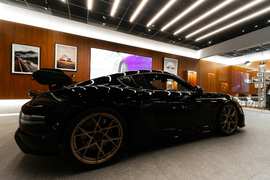
The 992.1 is a masterclass in aerodynamic downforce, generating a staggering 860kg (nearly 1,900 lbs) at 177 mph. This is achieved through a combination of an active front splitter and that iconic swan-neck rear wing. The wing isn’t just for show; it features a Drag Reduction System (DRS). With the push of a button, the flap flattens out to reduce drag on the straights, mirroring the technology found on high-performance supercars and professional racing chassis. Under the decklid sits the legendary 4.0L naturally aspirated flat-six, a high-revving masterpiece producing 525 horsepower that propels the car to 60 mph in just 3.2 seconds.
Spy Shots and the 992.2 Evolution: What to Expect
The automotive community has been buzzing with the latest sightings of the 992.2 Porsche 911 GT3 RS undergoing rigorous testing at the Nürburgring Nordschleife. At first glance, the camouflage hides a car that looks remarkably similar to its predecessor. Porsche follows an evolutionary design language, but as any seasoned exotic car specialist will tell you, the devil is in the details.
The spy photos reveal a familiar silhouette, including the aggressive side skirts and massive air intakes. However, the 992.2 facelift introduces subtle refinements to the lighting and rear fascia. While the standard 992.2 Carreras have integrated their turn signals into the main headlight housing, the GT3 RS prototypes appear to retain lower bumper-mounted lights, likely to prioritize airflow cooling for the braking system. The rear diffuser also shows signs of a redesign, featuring new vertical strakes and optimized air channels on either side of the center-exit exhaust. These tweaks are aimed at maximizing the Nürburgring lap record potential, as Porsche seeks to shave even more milliseconds off their current 6:44.85 benchmark.
The Great Engine Debate: Hybrid or Pure?
There has been significant speculation regarding the powertrain of the new 992.2. With Porsche introducing the 3.6L T-Hybrid system in the new GTS, many wondered if the Porsche 911 GT3 RS would follow suit. As an industry expert, I find this highly unlikely for three key reasons:
Weight Management: The RS philosophy is built on a “less is more” foundation. Adding batteries and electric motors adds weight—the ultimate enemy of lateral G-forces. To maintain its status as a lightweight performance car, Porsche must prioritize the power-to-weight ratio over raw hybrid torque.
Consistency in the GT Lineup: Porsche recently updated the 992.2 GT3, and notably, it retained the 4.0L naturally aspirated engine without electrification. It would be an architectural anomaly for the RS to pivot to a hybrid setup mid-cycle.
The GT2 RS Factor: For those seeking the absolute pinnacle of technology and hybrid-assisted speed, Porsche is developing the upcoming GT2 RS. That car is expected to utilize the twin-turbo hybrid flat-six to target the luxury sports car market’s power leaders. The GT3 RS, conversely, is about the connection between the driver’s right foot and the 9,000 RPM scream of a naturally aspirated engine.
Market Positioning and Competitive Landscape
The market for precision-engineered vehicles is more competitive than ever. Mercedes-AMG is currently testing a new, ultra-hardcore variant of the AMG GT, designed specifically to challenge Porsche’s dominance on the track. While the AMG GT offers incredible tech and a front-engine V8 grunt, it often struggles to match the surgical precision and rear-engine traction of the Porsche 911 GT3 RS.
For collectors and driving enthusiasts, the 992.2 GT3 RS represents more than just a car; it is a blue-chip investment vehicle. In an era where the industry is rapidly transitioning to electrification and forced induction, this model is widely considered the “Swansong” for the pure, atmospheric flat-six. This scarcity of mechanical purity has driven resale values through the roof, making it a sought-after asset for anyone tracking Porsche resale value and long-term appreciation.
The Driver’s Cockpit: Analog Meets Digital
Inside the cabin, the 992.2 is expected to adopt the fully digital instrument cluster seen in the rest of the 992.2 range. While some purists may miss the physical tachometer, the digital display allows for a “Track View” that prioritizes vital data like oil temperature, tire pressures, and G-meters. The steering wheel remains a busy hub of activity, featuring the four rotary dials that allow the driver to adjust the compression and rebound of the dampers, the locking percentage of the rear differential, and the level of traction control intervention in real-time. This level of race-derived technology allows a driver to transform the car’s behavior mid-lap to account for changing weather or tire wear.
Why the 911 GT3 RS Still Matters in 2025
In 2025, the automotive landscape is dominated by 0-60 mph times and digital screens. However, the Porsche 911 GT3 RS reminds us that driving is a physical, sensory experience. It’s the smell of hot brakes after a heavy session, the vibration of the flat-six through the carbon fiber bucket seats, and the confidence to trail-brake into a 100-mph sweeper knowing the aerodynamics are pinning you to the asphalt.
Porsche’s commitment to the RS badge ensures that the “soul” of the brand remains intact. Whether you are an amateur enthusiast looking to improve your lap times or a seasoned pro seeking the most communicative chassis on the market, the 992.2 GT3 RS stands alone. It isn’t just about breaking records; it’s about the art of the drive.
Secure Your Legacy on the Track
The window for naturally aspirated greatness is closing, and the upcoming 992.2 generation may be your final opportunity to own a piece of pure Porsche history. If you are ready to elevate your driving experience and command one of the most capable machines ever to grace a circuit, now is the time to act.
Contact your local authorized Porsche dealer or a specialized luxury automotive consultant today to discuss allocation opportunities and customization options for the new Porsche 911 GT3 RS.