
The Ultimate Guide to the World’s Most Expensive Cars in 2026
For the average consumer, vehicle shopping is a delicate dance of balancing budget constraints with practical needs. We look for reliable interest rates, fuel efficiency, and long-term resale value. However, there exists an elite strata of the automotive world where the price tag is merely an entry fee for status, engineering history, and, quite frankly, raw ego. As we move into 2026, the market for the most expensive cars has shifted from simple luxury to specialized, hyper-exclusive investment-grade hardware.
If you are a high-net-worth individual or a collector assessing your next big asset, you aren’t just buying a machine; you are buying a slice of automotive history. But before you dive into the deep end, let’s navigate the financial and mechanical landscape of these ultra-exclusive vehicles.
The 2026 Landscape: What Defines the “Most Expensive Cars”?
The definition of the most expensive cars in 2026 is no longer solely about leather seats or gold trim. It is about power-to-weight ratios, carbon fiber monocoques, and, most importantly, extreme scarcity. Most of these models see production runs of under 50 units. When the supply is this restricted, pricing is often decoupled from traditional automotive manufacturing costs—it becomes a matter of perceived scarcity and demand.
Rolls-Royce Droptail – $32 Million
The pinnacle of excess, the Droptail is not a production car in the traditional sense; it is a bespoke commission. With only four in existence, the cost is tied to the hundreds of hours of artisan labor, rare materials, and personal customization.
Red Bull RB17 – $6.8 Million
Designed by F1 legend Adrian Newey, this is the closest a civilian can get to driving a Formula 1 car. With only 50 units planned, it is a pure track weapon.
Pininfarina B95 – $4.8 Million
An “open-ski” electric hypercar, the B95 is a bold statement piece. With only 10 units destined for the world’s most elite garages, it is functionally a kinetic sculpture.
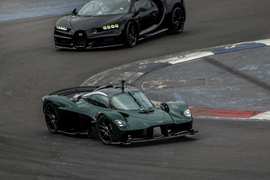
Aston Martin Valkyrie Spider – $4 Million
This vehicle represents the intersection of road-legal performance and Le Mans-grade racing tech. At $4 million, it remains one of the most aggressive investments in the Aston Martin ecosystem.
Koenigsegg Jesko Absolut – $3.4 Million
A Swedish engineering marvel. The Jesko Absolut is designed to shatter records. If you are looking for speed as a metric of value, this is the industry benchmark.
Gordon Murray T.50 – $3.2 Million
Gordon Murray has redefined the analog supercar. By rejecting heavy battery packs for a pure, naturally aspirated V12, the T.50 targets a specific investor: the purist who values the “connected” driving experience over the silent power of an EV.
Rimac Nevera R – $2.5 Million
The electric juggernaut. With 2,107 horsepower, the Nevera R is for the buyer who wants the fastest acceleration on the planet. It proves that electric performance is no longer the future—it is the current standard.
What This Means for You
If you are tracking the market for the most expensive cars, you are likely an investor or a high-end collector. You should view these purchases not as “cars” but as alternative assets. In my ten years of monitoring the exotic vehicle market, I have seen these machines act as hedges against inflation.
However, do not mistake a high price for a guaranteed profit. Much like real estate investment, location and timing matter. A limited-run Ferrari is often a safer bet than a startup hypercar due to brand heritage and long-term parts availability.
Should You Buy, Wait, or Invest?
If you are looking to enter the market:
Buy: If you can secure an allocation for a “first-of-its-kind” model (like a new hybrid-hypercar platform from a legendary manufacturer). These tend to appreciate immediately.
Wait: If the vehicle is an “EV-only” hypercar that is already losing competitive ground to the next generation of solid-state battery tech.
Invest: If the car has a manual transmission and a naturally aspirated engine (like the Gordon Murray T.33 or T.50). These are the “collector gold” of the next decade.
Best Financial Strategies for 2026
Managing your liquidity is vital when dealing with assets that cost millions.
Refinancing Opportunities: Many high-net-worth buyers utilize refinancing on their existing real estate portfolio to free up capital for these acquisitions. Do not drain your liquid cash; use low-interest-rate loans if you can leverage your current assets.
Insurance: The cost of insurance for a $32 million Rolls-Royce is often overlooked. Expect premiums to be in the six figures annually. Ensure you work with a broker who specializes in “Agreed Value” policies.
Comparison: Always compare the maintenance commitment. A Rimac requires specialized software support, whereas a V12 Ferrari may require more frequent, high-cost mechanical checkups.
Mistakes to Avoid That Could Cost You Money
I have seen many buyers make the mistake of “flipping” a car too early. If you purchase one of these vehicles, the tax implications can be severe depending on your local jurisdiction.
The “Waitlist Trap”: Don’t put down a $500,000 deposit on a car that is three years out if the company’s R&D is shaky. Verify the manufacturer’s liquidity.
Maintenance Neglect: A car that isn’t driven is a car that breaks. Not starting these engines regularly can lead to fuel degradation and sensor failures that cost tens of thousands to rectify.
Real-World Case Study: Buyer A vs. Buyer B
Buyer A purchased a limited-run hypercar at launch for $2.5 million. He kept it in a climate-controlled garage, never drove it, and sold it two years later. Due to market cooling and the release of a newer, faster version, he broke even after accounting for insurance and storage costs.
Buyer B purchased a similar model but focused on “provenance.” He drove the car to major events (like Pebble Beach), kept meticulous service records, and built a relationship with the manufacturer. When he sold, he made a 25% profit.
The Lesson: Documentation, branding, and participation in the community are just as important as the car itself.
Final Verdict
The most expensive cars are not for everyone. They require a sophisticated understanding of the market, a high tolerance for operational costs, and a clear exit strategy. Whether you are looking at the blistering speed of a Rimac or the hand-crafted soul of a Rolls-Royce, approach the transaction like any other high-stakes real estate investment.
Are you ready to elevate your collection? Compare your financing options today, check current luxury automotive auction results, and ensure your portfolio is protected with the best insurance coverage available. Your dream machine is waiting—make sure you’re positioned to own it, not just buy it.