
Race-Bred Performance: 10 Iconic Production Vehicles With Engines Forged on the Track
There is an electrifying sensation that comes from piloting a machine infused with genuine motorsport DNA. We aren’t merely discussing aesthetic “sport” packages or carbon fiber trim; we are talking about the visceral, high-revving soul of a car: the engine. For over a century, the crucible of competition has served as the ultimate laboratory for automotive innovation. When a manufacturer decides to transplant a race-bred engine directly into a street-legal chassis, the result is a vehicle that defies the conventional boundaries of a production vehicle.
As an industry consultant with over a decade of experience tracking powertrain evolution, I’ve seen how the “Win on Sunday, Sell on Monday” philosophy has shifted from a marketing slogan to a rigorous engineering standard. Today, the demand for high-performance cars with authentic racing pedigree is at an all-time high, driving up the value of vehicles that offer a direct mechanical link to the podium. From the screaming V12s of Maranello to the turbocharged dominance of Ford’s EcoBoost program, these are the machines that brought the track to the tarmac of public roads.
The Engineering Bridge: Why Motorsport DNA Matters in 2025
In the modern automotive landscape, the term motorsport DNA is often used loosely, but its technical definition is rooted in survival. Racing environments subject components to thermal and mechanical stresses that no road car would ever encounter in a standard commute. This “trickle-down” effect is responsible for the ubiquity of carbon-ceramic brakes, active aerodynamics, and sophisticated dual-clutch transmissions.
However, the most significant transfer of technology occurs within the internal combustion engine. Developing a race-bred engine requires immense capital investment. By utilizing these powerplants in a production vehicle, manufacturers can amortize those costs while elevating their brand’s prestige. For the enthusiast, it means owning a piece of history—a vehicle that breathes, vibrates, and accelerates with the urgency of a Le Mans prototype or a Formula 1 contender.

Alfa Romeo Montreal: The Endurance Heritage
The Alfa Romeo Montreal is a masterclass in 1970s Italian style, but its true beauty lies beneath the hood. It features a 2.6-liter V8 derived from the legendary Tipo 33 sports prototype. This engine wasn’t just inspired by racing; it was an endurance veteran that competed at the Targa Florio and Daytona.
While the Montreal’s version was modified for road manners, it retained the dry-sump lubrication and high-revving nature of its predecessor. Producing 200 hp and screaming up to 7,000 RPM, the Montreal remains one of the most soulful high-performance cars ever to emerge from Milan.
BMW M-Division Icons: M1, E30 M3, and the M5
BMW’s “M” originally stood for Motorsport, and no era exemplified this better than the late 70s and 80s. The BMW M1 utilized the M88 inline-six, a 3.5-liter masterpiece developed for the ProCar series. This same high-strung engine eventually found its way into the E28 M5 and E24 M6, effectively creating the “super sedan” category.
Perhaps even more famous is the E30 M3. Its S14 four-cylinder engine was essentially a truncated version of the M88/M12 F1 block. Built to satisfy Group A touring car homologation rules, the E30 M3 wasn’t designed to be a luxury cruiser; it was a race car sold in showrooms, a true production vehicle with a singular focus on winning the DTM championship.
1969 Chevrolet Camaro ZL1: The Drag Strip Legend
When discussing motorsport DNA in American muscle, the 1969 Camaro ZL1 stands alone. At its heart sat an all-aluminum 427 cubic-inch (7.0-liter) V8. This engine was originally blueprinted for the brutal Can-Am racing series, where lightweight construction and massive displacement were king.
While officially rated at 430 hp to appease insurance companies, these engines frequently dynoed at over 500 hp. Only 69 units were produced, making the ZL1 one of the rarest and most expensive high-performance cars in the collector market. It represented the absolute pinnacle of Chevy’s factory-backed drag racing efforts.
Ferrari Dino 206 GT: The Formula 2 Connection
The Dino 206 GT holds a special place in Ferrari history. Named after Enzo’s son, it was powered by a 2.0-liter V6 that traced its lineage directly to Ferrari’s Formula 2 program of the 1960s. This high-revving V6 delivered 180 hp, a formidable figure for a car weighing just over 2,000 pounds.
This production vehicle was revolutionary for the brand, introducing the mid-engine layout that would define the next several decades of Ferrari supercars. The Dino’s engine note—a mechanical symphony of valves and intake roar—remains one of the most distinctive in automotive history.
Ferrari F50: An F1 Car for the Street
If the Dino was a nod to F2, the Ferrari F50 was a literal translation of Formula 1 technology. Built for the company’s 50th anniversary, the F50 used the Tipo F130B 4.7-liter V12. This engine was a direct descendant of the 1990 F1-90 car driven by Alain Prost.
The engine was even bolted directly to the chassis to act as a stressed member, just like in a Grand Prix car. With a redline of 8,500 RPM and 513 hp, the F50 offered a raw, unassisted driving experience that modern high-performance cars struggle to replicate. It remains the closest any enthusiast can get to a 1990s F1 cockpit.
Ford GT: From Le Mans to the Showroom
The Ford GT is a nameplate synonymous with endurance racing. The 2005 iteration utilized a 5.4-liter supercharged V8 that shared its architecture with the Daytona Prototype engines. It was a torque-rich monster that honored the GT40’s legacy of American dominance.
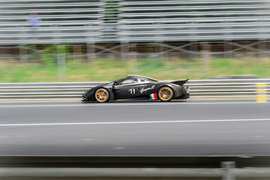
In 2017, Ford doubled down on motorsport DNA by releasing a new GT powered by a 3.5-liter twin-turbo EcoBoost V6. This powertrain was developed concurrently with the Chip Ganassi Racing program that won its class at Le Mans in 2016. It is a prime example of how modern production vehicles use turbocharging and sophisticated electronics to achieve 647 hp while maintaining a direct link to the winner’s circle.
Jaguar XJ220: The Group C Survivor
The Jaguar XJ220’s path to production was controversial, but its engineering was undeniable. Originally promised with a V12, the production version arrived with a 3.5-liter twin-turbo V6 lifted from the XJR-11 Group C race car.
Despite the initial outcry from purists, this race-bred engine propelled the XJ220 to a top speed of 217 mph, briefly holding the title of the world’s fastest production car. The XJ220 proved that racing tech, specifically small-displacement forced induction, was the future of the supercar.
1964 Plymouth Belvedere: The “Race Hemi”
The Plymouth Belvedere might look like a standard 1960s sedan, but the 426 Hemi V8 under its hood was a weapon designed for NASCAR. Known as the “Elephant Engine,” this race-bred engine was so dominant on the oval tracks that it forced NASCAR to change its rules regarding engine availability to the public.
Producing a conservative 425 hp, the Belvedere Hemi was a thinly veiled race car that helped define the golden age of Mopar performance. It established a legacy of high-displacement power that continues to influence modern American high-performance cars.
Porsche 918 Spyder: The Hybrid Pioneer
The Porsche 918 Spyder redefined what a production vehicle could achieve by blending electric torque with a high-revving internal combustion engine. Its 4.6-liter V8 was based on the architecture of the RS Spyder LMP2 prototype.
Combined with its hybrid system, the 918 produced a staggering 887 hp and 944 lb-ft of torque. It was a technological tour de force that showed the world how motorsport DNA could be adapted for a sustainable, high-performance future. Even in 2025, its 0-60 mph time of 2.2 seconds remains the benchmark for hypercars.
Porsche Carrera GT: The Shelved F1 Project
The Porsche Carrera GT is widely considered the greatest analog supercar of all time. Its heart is a 5.7-liter V10 that was originally designed for a Footwork Formula 1 car in the early 90s. When that project was canceled, the engine was repurposed for a Le Mans prototype, which was also shelved.
Ultimately, Porsche decided this incredible engine deserved a home in a production vehicle. The Carrera GT’s V10 produces 603 hp and features a scream that is often compared to a fighter jet. With no stability control and a ceramic clutch, it requires the hands of an expert to master, making it the ultimate expression of a race-bred engine on the road.
Why Collectors are Chasing Race-Bred Engines in 2025
As we move toward an era of increased electrification, the value and allure of a production vehicle with a mechanical heartbeat forged in racing are skyrocketing. Enthusiasts are looking for more than just 0-60 times; they are seeking “engagement,” a quality that a race-bred engine provides in spades through its unique vibration, sound, and power delivery.
Investing in a vehicle with authentic motorsport DNA isn’t just about speed—it’s about owning a piece of engineering history. These cars represent the moments when manufacturers stopped worrying about comfort and focused entirely on the pursuit of victory. Whether it’s a vintage Alfa or a modern Porsche, these machines offer a driving experience that is unfiltered, unapologetic, and undeniably thrilling.
Ready to find your next track-inspired masterpiece? The world of high-performance automotive engineering is evolving rapidly, but the thrill of a race-bred engine remains timeless. Whether you are looking to invest in a classic like the E30 M3 or eyeing a modern hybrid hypercar, understanding the pedigree behind the powertrain is the first step toward a truly legendary ownership experience. Explore our latest market deep-dives and expert reviews to stay ahead of the curve in the world of high-performance motoring.