
From Grid to Garage: 10 Street-Legal Legends with Genuine Race Engines
There is a visceral, unmistakable thrill that comes with piloting a machine infused with authentic motorsport DNA. We aren’t merely discussing aesthetic trim packages or “track-inspired” suspension tuning; we are highlighting a rare breed of production vehicles that house power plants originally forged for the podium. These high-revving, adrenaline-pumping masterpieces represent the pinnacle of high-performance automotive engineering, offering drivers a direct, mechanical link to the endurance racers and open-wheel icons that dominated the world’s most prestigious circuits.
As we move through 2025, the secondary market for these exotic car investments continues to skyrocket. Collectors and driving enthusiasts alike are searching for that “last of a kind” feel—the raw, unfiltered feedback of a race-bred engine in a street-legal chassis. In this deep dive, we explore 10 legendary vehicles that successfully blurred the lines between the paddock and the pavement.
The Synergy of Track Innovation and Street Performance
The relationship between professional motorsport and consumer road cars has always been a symbiotic one. Racing serves as the ultimate laboratory—a high-stakes environment where cutting-edge engine technology is pushed to the breaking point under extreme thermal and mechanical stress. The innovations born in the pits eventually “trickle down” to the showroom floor, manifesting as superior thermal management, advanced aerodynamics, and lightweight carbon-fiber composites.
Historically, the “Win on Sunday, Sell on Monday” mantra drove sales, but today, it’s about brand equity and technical prowess. When an OEM invests millions into a Le Mans or Formula 1 program, the resulting street cars benefit from a level of scrutiny that standard passenger cars never see. Whether it’s the advent of carbon-ceramic brakes or the transition to sophisticated hybrid performance systems, the track remains the ultimate proving ground for the best luxury sports cars on the market.
Alfa Romeo Montreal: The Endurance Heart

The Alfa Romeo Montreal is perhaps one of the most aesthetically striking coupes of the 1970s, but its true beauty lies beneath the vented hood. It features a 2.6-liter V8 derived directly from the Alfa Romeo Tipo 33—a legendary endurance racer that competed at the Targa Florio and the 24 Hours of Daytona.
While the engineers detuned the engine for civil road use, it never lost its high-strung personality. This vintage Italian sports car delivers 200 hp and screams to a 7,000 RPM redline. For collectors looking for classic car value, the Montreal remains an undervalued gem compared to its peers from Maranello, despite its purebred racing pedigree.
BMW’s M Division Icons: M1, M3, and Beyond
When discussing BMW M performance, you cannot overlook the M88 inline-six. Originally developed for the mid-engine BMW M1 and the M1 ProCar series, this engine was a masterpiece of 24-valve technology. It didn’t just stay in the M1; it found its way into the E24 M6 and the E28 M5, essentially birthing the “super sedan” category.
Equally impressive was the E30 M3’s S14 four-cylinder. Taking cues from both the M88 and the turbocharged BMW engines that powered Formula 1 cars in the 80s, the S14 was designed for DTM touring car racing. It wasn’t about massive torque; it was about high-revving efficiency and balance, making the E30 M3 one of the best handling cars in automotive history.
1969 Chevrolet Camaro ZL1: A Can-Am Terror
In the world of American muscle cars, the 1969 Camaro ZL1 is the undisputed king of the drag strip. At its core was a 427-cubic-inch (7.0-liter) all-aluminum V8. This wasn’t a standard big block; it was a specialized unit built for Can-Am racing, where weight and power density were everything.
Officially rated at 430 hp (though real-world figures hovered near 500 hp), the ZL1 was a “secret” RPO (Regular Production Option) intended for professional racers. Today, these are among the most expensive collector car auctions items, frequently fetching seven figures. It represents a time when Chevrolet performance was operating with a “no limits” philosophy.
Ferrari Dino 206 GT: The Formula 2 Connection
Named after Enzo Ferrari’s son, the Dino 206 GT was a pivotal moment for the brand. It utilized a 2.0-liter V6 that had its origins in Formula 2 racing. This mid-engine layout was a radical departure for Ferrari at the time, prioritizing agility over the brute force of a V12.
The Ferrari Dino produced 180 hp, which, when paired with a featherweight 2,000-pound chassis, created a sublime driving experience. It proved that a race-bred engine didn’t need twelve cylinders to provide world-class engagement. As luxury car financing for vintage Ferraris becomes more accessible to high-net-worth individuals, the Dino’s status as a pure driver’s car continues to grow.
Ferrari F50: An F1 Car in Evening Wear
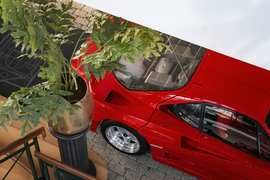
If the Dino was a nod to F2, the Ferrari F50 was a love letter to Formula 1. To celebrate fifty years of excellence, Ferrari took the 3.5-liter V12 from the 1990 Tipo 641 F1 car—driven by Alain Prost—and bored it out to 4.7 liters for road use.
This is not a “race-inspired” car; it is a race car. The engine is a stressed member of the chassis, meaning the vibrations of the V12 are transmitted directly to the driver’s spine. With a 513 hp output and an 8,500 RPM limit, the F50 provides an auditory experience that remains unmatched by modern turbocharged supercars. For those seeking the highest ROI on exotic cars, the F50’s rarity and F1 DNA make it a blue-chip asset.
Ford GT: From Le Mans to the Local Highway
The Ford GT exists because of a grudge and a victory at Le Mans. The 2005 iteration utilized a 5.4-liter supercharged V8 that shared architecture with Ford’s Daytona Prototype engines. It was a mechanical beast that provided old-school American muscle with world-class mid-engine balance.
Fast forward to 2017, and the Ford GT returned with a 3.5-liter twin-turbo EcoBoost V6. While some purists missed the V8, this V6 was a direct descendant of the engine that won its class at Le Mans in 2016. It showcased how forced induction technology and active aerodynamics could redefine American supercar performance.
Jaguar XJ220: The Group C Speed King
The Jaguar XJ220 is a masterclass in “pivot and conquer.” While the concept featured a heavy V12, the production version utilized a 3.5-liter twin-turbo V6 from the Jaguar XJR-11 Group C race car.
This change initially caused controversy, but the results were undeniable. The XJ220 clocked a top speed of 217 mph, briefly holding the title of the world’s fastest production car. Its track-proven reliability and aerodynamic profile made it a legend of the 90s, and it remains a cornerstone of British automotive heritage.
Plymouth Belvedere: The “Race Hemi” Domination
Long before the modern “Hellcat” era, the 1964 Plymouth Belvedere was terrorizing NASCAR tracks. The heart of this beast was the 426 Hemi V8, an engine so dominant that NASCAR eventually changed its rules to limit its usage.
To keep the Hemi legal for competition, Plymouth had to sell a specific number of road-going versions. These “street Hemis” produced 425 hp and turned a humble sedan into one of the most feared classic muscle cars of all time. It’s a perfect example of how motorsport regulations directly influenced the horsepower wars of the 1960s.
Porsche 918 Spyder: The Hybrid Revolution
The Porsche 918 Spyder redefined what a hypercar could be. Its 4.6-liter V8 didn’t start in a road car; it was a development of the engine used in the Porsche RS Spyder LMP2 racer. Porsche then paired this high-revving V8 with a sophisticated hybrid powertrain.
The result? A combined 887 hp and a 0-60 mph time of just 2.2 seconds. The 918 proved that sustainable performance didn’t have to be boring. It integrated regenerative braking and electric torque fill to enhance the racing engine, creating a seamless bridge to the future of high-end electric vehicles.
Porsche Carrera GT: The Shelved F1 Masterpiece
Widely considered the “greatest analog supercar,” the Porsche Carrera GT owes its existence to a canceled racing program. The 5.7-liter V10 was originally designed for a Footwork Formula 1 car in the early 90s. When that project stalled, the engine was repurposed for a Le Mans prototype, which was also shelved.
Finally, Porsche decided to put this 603 hp masterpiece into a production car. With no stability control and a ceramic twin-plate clutch, the Carrera GT is notoriously difficult to master. However, for those who can handle its motorsport DNA, it offers the most raw and rewarding V10 symphony ever allowed on a public road.
Why Race-Bred Engines Matter in 2025
As the automotive industry shifts toward total electrification, the era of the naturally aspirated race engine is drawing to a close. This transition has made vehicles with genuine competition history more than just cars—they are historical artifacts. Investing in a vehicle with a race-bred engine is about more than just speed; it’s about owning a piece of engineering history that was never meant to be compromised by mass-market requirements.
Modern track-day cars often try to mimic this feeling through software, but there is no substitute for the mechanical purity of an engine designed to win a 24-hour endurance race. Whether you are a collector looking for the next big automotive investment or an enthusiast seeking the ultimate weekend toy, these ten cars represent the peak of what happens when the boardroom steps aside and lets the racing engineers take the lead.
Ready to find your own piece of racing history? Whether you are looking to acquire a modern hypercar or a classic muscle legend, the market for race-derived machinery is more competitive than ever. Start your journey by connecting with a specialist broker or exploring our curated listings of high-performance luxury vehicles today, and put the power of the podium in your own garage.