
From Grid to Garage: The Ultimate Guide to Road Cars with Race-Bred Engines
There is a visceral, unmistakable thrill that comes from piloting a machine infused with genuine motorsport DNA. We aren’t merely discussing aesthetic “track packs” or aggressive body kits that mimic the look of a racer. We are talking about the rare breed of production vehicles that house high-revving, fire-breathing race-bred engines originally forged for the most grueling competition stages on earth. These power plants, born in the high-pressure environments of Le Mans, Formula 1, and Group C, bring a raw, unadulterated performance to the public tarmac, offering a direct mechanical link to the icons of the circuit.
As an industry veteran with over a decade of experience analyzing automotive engineering and market trends, I’ve seen countless “race-inspired” marketing campaigns. However, only a handful of cars truly bridge the gap between the starting grid and the suburban driveway. In this deep dive, we explore 10 legendary production vehicles that redefined performance by utilizing race-bred engines.
The Engineering Philosophy: Why Race Tech Matters in 2025
The synergy between motorsport and road cars has always been the primary catalyst for automotive innovation. Racing is the ultimate laboratory; it is where engineers push thermal limits, structural integrity, and fluid dynamics to the breaking point. When you invest in a vehicle with a race-bred engine, you aren’t just buying speed—you are buying a legacy of durability and high-tensile engineering.
In the current 2025 landscape, where electrification is becoming the norm, the demand for these mechanical masterpieces has skyrocketed. Collectors are willing to pay a premium for the auditory and tactile feedback that only a high-RPM, track-derived motor can provide. This is reflected in the high exotic car valuation and the surging interest in classic car investment. From advanced aerodynamics to carbon-fiber composites, the “trickle-down” effect of racing ensures that the car you drive today is safer, faster, and more efficient.
Alfa Romeo Montreal: The Endurance Prototype for the Street
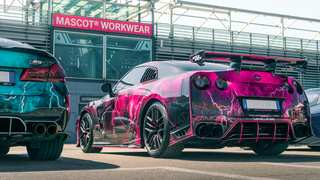
The Alfa Romeo Montreal is perhaps one of the most aesthetically striking examples of 1970s Italian design, but its true soul lies beneath the vented hood. It features a 2.6-liter naturally aspirated V8 derived directly from the Tipo 33 sports prototype—a car that famously battled for glory at the Targa Florio and the 24 Hours of Daytona.
While the Montreal’s version was slightly detuned for reliability on public roads, it retained its high-revving character, screaming all the way to a 7,000 RPM redline. For those looking for affordable vintage supercars, the Montreal remains a connoisseur’s choice, offering 200 hp and a soundtrack that rivals anything from Maranello.
BMW’s M Division: Mastering the M88 and S14
When discussing high-performance German cars, BMW’s M division stands as the gold standard for transferring track success to the showroom floor. The legendary BMW M1 utilized the M88 3.5-liter inline-six, a motor born from the M1 ProCar series. This engine was so formidable that it was later transplanted into the E24 M6 and the E28 M5, effectively creating the luxury performance sedan segment.
Simultaneously, the E30 M3—often cited as the greatest driver’s car of all time—employed the S14 four-cylinder. This engine wasn’t a modified economy block; it was essentially a truncated version of the M88, utilizing the same head architecture and inspiration from BMW’s Formula 1 turbo programs. It was designed specifically to win DTM (Deutsche Tourenwagen Masters) titles, making the road-going M3 a true homologation special.
Chevrolet Camaro ZL1: The Can-Am Muscle Monster
In 1969, Chevrolet decided to break all the rules with the Camaro ZL1. At its heart was a 7.0-liter (427 cubic-inch) all-aluminum V8 originally developed for the brutal Can-Am racing circuit. In an era of heavy iron blocks, the ZL1’s aluminum construction was a revelation, shedding weight while delivering massive torque.
Though officially rated at 430 hp to appease insurance companies, most experts agree these engines produced closer to 500 hp in race trim. With only 69 units produced, the 1969 ZL1 is a cornerstone of American muscle car history and a prime example of a high-performance vehicle that was essentially a drag racer with a license plate.
Ferrari Dino 206 GT: The Legacy of Formula 2
The Ferrari Dino 206 GT holds a special place in the hearts of purists. Named after Enzo Ferrari’s son, the car featured a 2.0-liter V6 engine that was a direct descendant of the power units used in 1960s Formula 2 racing. This high-revving V6 allowed the Dino to be nimble and balanced, a stark contrast to the heavy V12 grand tourers of the time.
While it didn’t wear the Prancing Horse badge initially, the Dino’s racing pedigree was undeniable. Its mid-engine layout and 180 hp output proved that you didn’t need twelve cylinders to deliver a world-class driving experience. Today, it is recognized as the blueprint for the modern V6 supercar.
Ferrari F50: A Formula 1 Car in Evening Wear
If the Dino was a nod to F2, the Ferrari F50 was a love letter to the pinnacle of motorsport. Created to mark the brand’s 50th anniversary, the F50 is as close as one can get to a street-legal F1 car. Its 4.7-liter V12 (Tipo F130B) was adapted from the engine found in the 1990 Ferrari 641 F1 car driven by Alain Prost.
The F50’s engine is bolted directly to the chassis, acting as a stressed member—just like a race car. This results in an unfiltered, vibrating, and visceral experience that modern supercars, muffled by turbochargers and regulations, simply cannot replicate. With an 8,500 RPM limit and 513 hp, the F50 remains a peak achievement in naturally aspirated engine design.
Ford GT: From Le Mans to the Modern Era
The Ford GT nameplate is synonymous with the “Total Performance” era of the 1960s. The 2005 iteration paid tribute to the GT40 with a 5.4-liter supercharged V8 that shared its architecture with Ford’s Daytona Prototype programs.
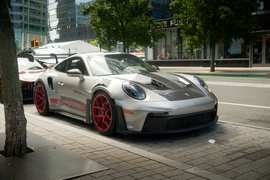
Fast forward to 2017, and Ford once again looked to the track. The second-generation GT utilizes a 3.5-liter twin-turbo EcoBoost V6. While some purists missed the V8 rumble, the V6 was a proven winner, having been developed alongside the CGR (Chip Ganassi Racing) endurance cars that won their class at Le Mans. This vehicle represents the modern shift toward turbocharged performance and aerodynamic efficiency.
Jaguar XJ220: The Group C Speed King
The Jaguar XJ220 was once the fastest production car on the planet, reaching a top speed of 217 mph. While the concept car promised a V12, the production version arrived with a 3.5-liter twin-turbo V6. Far from a disappointment, this was the same engine used in the Jaguar XJR-11 Group C race car.
The XJR-11 was a beast on the track, and that DNA translated into 542 hp of raw power for the road. The XJ220’s motorsport-derived heart allowed it to punch far above its weight class, cementing its status in the 90s supercar hall of fame. For collectors looking for high-growth automotive assets, the XJ220 is currently seeing a massive resurgence in value.
Plymouth Belvedere: The NASCAR “Race Hemi”
In 1964, the Plymouth Belvedere looked like a standard American sedan, but it hid a secret that would terrify every other driver at a stoplight: the 426 Hemi V8. This was the “Race Hemi,” a motor built specifically to dominate the high banks of NASCAR.
The Hemi was so dominant that NASCAR actually banned it for a period, forcing Plymouth to sell a specific number of units to the public for “homologation” purposes. The road-going version produced 425 hp and 490 lb-ft of torque, turning the Belvedere into a legend of the Mopar world. It remains one of the most iconic big-block V8 engines ever produced.
Porsche 918 Spyder: Hybrid Tech Meets LMP2 Power
The Porsche 918 Spyder proved that the future of performance could be green—if that green was mixed with high-octane racing fuel. Its 4.6-liter V8 wasn’t a clean-sheet design; it was based on the architecture of the RS Spyder, a prototype that dominated the LMP2 class at Le Mans.
By pairing this race-bred engine with a sophisticated hybrid system, Porsche achieved a combined output of 887 hp. This allowed the 918 to shatter Nürburgring records and set a new standard for hypercar performance. It remains a masterclass in how hybrid technology can enhance, rather than stifle, the racing soul of a vehicle.
Porsche Carrera GT: The Shelved F1 Project
Many enthusiasts consider the Porsche Carrera GT the greatest analog supercar ever built. Its heart is a 5.7-liter V10 that has one of the most fascinating backstories in the industry. The engine was originally designed for a Formula 1 project in the early 90s, then reworked for a Le Mans prototype (the LMP2000) that was ultimately cancelled.
Rather than let the engineering go to waste, Porsche placed this V10 into the Carrera GT. The result is a 612 hp masterpiece with a ceramic clutch and a manual transmission. The sound of a Carrera GT at 8,000 RPM is often compared to a screaming F1 car, making it a “must-have” for any serious luxury car collection.
Conclusion: The Enduring Appeal of Race-Bred Engineering
As we move further into the decade, the opportunity to own a vehicle with a direct link to the racetrack is becoming increasingly rare. These production vehicles represent the pinnacle of what happens when engineers are given the freedom to bring competition-grade hardware to the street. Whether it’s a classic Ferrari or a modern Porsche hypercar, the soul of a race-bred engine provides an emotional connection that “software-tuned” modern cars often lack.
The transition toward digital and electric platforms means that these mechanical marvels are not just cars; they are historical artifacts of a high-octane era. For the enthusiast, there is no substitute for the precision, the sound, and the sheer pedigree of a motor born for the podium.
Are you ready to experience the raw power of a track-derived machine? Whether you are looking to start your journey into collector car acquisition or simply want to learn more about the engineering behind your favorite brands, the world of race-bred road cars offers endless discovery. Start your search today and find a vehicle that doesn’t just get you from A to B—it takes you to the finish line.