

The Porsche 911 GT3 RS: Evolution of an Apex Predator
For over a quarter-century, the Porsche 911 GT3 RS has been more than just a car; it’s a philosophy etched in carbon fiber and drenched in motorsport DNA. It represents the relentless pursuit of track-day perfection, a machine engineered to push the boundaries of what’s possible on asphalt. From its nascent days in the 996 generation to the sophisticated 992.1 iteration, the GT3 RS has consistently redefined hardcore performance, setting benchmarks that have left rivals gasping in its wake. As the automotive landscape shifts, with whispers of electrification and hybrid powertrains dominating headlines, the question arises: what does the future hold for this iconic track-focused 911, and can it maintain its visceral, analog soul?
The story of the GT3 RS is one of intentional escalation. When Porsche first introduced the GT3 variant of the 996 911 back in 1999, it was widely perceived as the zenith of factory-prepared track capability. Its race-tuned flat-six engine, featherlight construction, and homologation-driven development solidified its status as the ultimate 911 for the purist. Yet, within the hallowed halls of Porsche’s engineering department, a collective itch remained. A belief that “ultimate” was merely a stepping stone. With a touch more ingenuity and a dash more dedication, they knew they could transcend even that lofty standard.
This ambition culminated in the facelifted 996.2 GT3 RS. This wasn’t just a minor iteration; it was a focused evolution. Porsche meticulously shaved more weight through lighter wheels and revised body panels, coaxed a few extra horsepower from the already potent engine, and subtly refined the aerodynamics. The result was a car so raw, so directly descended from the racetrack, that it rendered the standard GT3 almost pedestrian by comparison. For two decades since, the GT3 RS has remained an undisputed titan of every track day, a legend etched into the memory of enthusiasts worldwide.
The current iteration, the 992.1 generation GT3 RS, represents the most extreme distillation of this track-focused ethos to date. It embodies a level of hardcore engineering that borders on the obsessive. The carbon fiber bonnet, a striking visual cue, houses a central radiator with prominent “nostril” outlets that artfully channel airflow over the roof, a testament to its aerodynamic sophistication. Beyond aesthetics, functionality reigns supreme: a hydraulically adjustable front splitter, reminiscent of the Turbo S, allows for on-the-fly aerodynamic tuning, while underbody flaps work in concert to sculpt the air. The colossal swan-neck rear wing, a defining feature, incorporates DRS (Drag Reduction System), a technology borrowed directly from Formula 1 and celebrated supercars like the McLaren P1, allowing for adjustable downforce characteristics.
The mechanical symphony under the skin is equally impressive. Adjustable, race-derived suspension provides unparalleled control over the chassis, while dynamic engine mounts ensure optimal power delivery under extreme G-forces. Large air intakes dominate the flanks, feeding the beast within, and aggressive side skirts enhance aerodynamic efficiency. At its heart beats a 4.0-liter naturally aspirated flat-six engine, belting out a formidable 525 horsepower. The cumulative effect of this meticulous engineering is staggering: 0-62 mph in a mere 3.2 seconds, an astounding 860 kilograms of downforce at 177 mph, and a breathtaking Nürburgring lap time of 6:44.85. This is a machine so far removed from a standard GT3 that comparing them is akin to contrasting an eagle with a swallow – both are birds, but their operational domains and inherent capabilities are worlds apart.
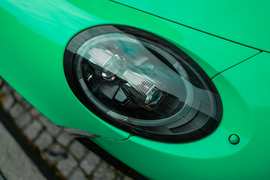
Now, as the automotive world eagerly anticipates the arrival of the 992.2 generation GT3 RS, recent spy shots confirm that the final phase of testing is underway at its spiritual home, the Nürburgring. True to Porsche’s evolutionary design philosophy, the camouflaged prototype offers subtle hints of refinement rather than radical departure. It retains the iconic central radiator with its distinctive “nostril” outlets, the imposing swan-neck rear wing with DRS, the substantial air intakes, and the familiar side skirts. Even the door handles, a seemingly minor detail, remain consistent. A notable, albeit subtle, change is the relocation of the front turn signals to a lower position, a departure from some 992.2 variants that integrate them into the headlight units. The rear diffuser has also seen minor revisions, featuring new, discreet intakes flanking the exhaust. While it remains uncertain whether the 992.2 GT3 RS will adopt the digital dashboard now prevalent across the 992.2 range, its overall silhouette is unmistakably that of the aggressive, uncompromising track car that the GT3 RS has always been.
Speculation has inevitably turned to powertrain. Rumors abound regarding the potential adoption of the 3.6-liter twin-turbo hybrid flat-six engine that has become a staple of many 992.2 models, a unit that promises a significant boost in horsepower over the outgoing 4.0-liter naturally aspirated engine. However, from my vantage point as an industry veteran with a decade immersed in the nuances of performance engineering, I remain skeptical. Several factors lead me to believe this path is unlikely for the GT3 RS.
Firstly, if Porsche intended to standardize its hybrid powertrain across the 911 range, it’s logical they would have integrated it into the standard GT3 first. The fact that they haven’t suggests a deliberate decision to maintain differentiation. Secondly, while Porsche’s engineers have performed miracles in refining the hybrid unit, it inherently carries additional weight compared to its naturally aspirated predecessor. For a car that defines itself by its relentless pursuit of lightness and agility, adding mass is almost sacrilegious. But perhaps most critically, fitting a hybrid system solely for the sake of increased power output fundamentally misinterprets the spirit of the GT3 RS. At its core, the GT3 and GT3 RS are designed to be raw, engaging driving instruments, thrilling the driver through mechanical connection and feedback, not simply to shatter lap records with brute force. That particular ambition, in my estimation, is reserved for the forthcoming GT2 RS.
The GT2 RS, a moniker synonymous with outright blistering performance, is the more likely recipient of the potent 3.6-liter hybrid flat-six. Porsche understands that the discerning GT3 RS customer seeks the purest, most mechanical, and ultimately most thrilling track-focused experience available. To compromise the signature naturally aspirated flat-six, with its linear power delivery and intoxicating soundtrack, would be to betray the very essence of this legendary model. This is especially true when considering the very real possibility that the current 4.0-liter engine might be bidding farewell. This could very well be the swansong for this glorious powerplant, a final, unadulterated roar before the march of progress dictates otherwise.
The competitive landscape is also intensifying. Mercedes-Benz recently unveiled spy shots of its new track-focused AMG GT, a machine poised to challenge either the upcoming GT2 RS or perhaps even the GT3 RS itself. While the AMG GT appears formidable, it will need to possess an almost supernatural ability to truly rival the innate track prowess of the GT3 RS. There is a profound reason why this particular lineage has endured for over two decades, consistently setting the bar for track-bred performance. And as the end of an era, or at least a significant chapter, appears to be on the horizon, it’s undeniable that if this is indeed the final act for the naturally aspirated flat-six in the GT3 RS, it will depart with a thunderous, unforgettable Flat-6 crescendo.
For those yearning to experience the pinnacle of track-day engineering, the search for the ultimate performance vehicle often leads to specialized dealerships and marque-specific events. Whether you’re a seasoned track enthusiast in Los Angeles seeking a pre-owned Porsche 911 GT3 RS for sale, or a collector in Miami looking for the latest new Porsche GT3 RS model, the journey to ownership is as exhilarating as the drive itself. Exploring performance car dealerships near me that specialize in high-performance vehicles can provide access to the latest models and highly sought-after pre-owned examples.
The relentless evolution of the Porsche 911 GT3 RS is a testament to engineering excellence and an unwavering commitment to the thrill of driving. As the automotive industry navigates the complexities of electrification and evolving performance paradigms, the GT3 RS stands as a beacon of pure, unadulterated driving pleasure. For those who understand that the true measure of a sports car lies not just in horsepower figures but in the visceral connection between driver, machine, and the road, the GT3 RS offers an experience unlike any other.
If you’re ready to move beyond the dream and into the driver’s seat, we invite you to explore the possibilities. Contact your local authorized Porsche dealership to discuss the current 911 GT3 RS offerings, or explore reputable performance car brokers who can assist in sourcing your perfect track-day companion. The journey to experiencing the legend begins with a single step – are you ready to take it?