
Engineering Excellence: 10 Legendary Production Cars with True Motorsport DNA
There is an electrifying sensation that only occurs when you turn the ignition of a vehicle engineered with pure motorsport DNA. We aren’t talking about cosmetic racing stripes or lowered suspension kits; we are talking about authentic, track-bred power plants that have been tamed just enough for public asphalt. These high-performance engines, forged in the crucible of professional competition, offer enthusiasts a visceral, mechanical connection to the world’s most iconic race circuits.

After a decade in the automotive industry, I’ve seen countless “special editions” that offer little more than interior trim upgrades. However, the cars that truly define the intersection of track and road are those where the internal combustion heart was literally beating in a racing prototype months before hitting the assembly line. Let’s explore ten production vehicles that blur the lines between race cars and daily drivers, and why the pursuit of motorsport DNA remains the gold standard for high-end automotive engineering.
The Symbiosis of Track and Street
Motorsport is the ultimate laboratory. When manufacturers invest millions into racing, they are doing more than chasing trophies; they are stress-testing materials, thermodynamics, and aerodynamics under conditions where failure results in catastrophe. This motorsport DNA trickles down to consumer vehicles, accelerating innovation. From the development of advanced carbon-fiber composites to high-efficiency fuel injection systems and paddle-shift transmissions, the evolution of the road car is inextricably linked to the podium finishes of the past.
When a brand dominates a series like Formula 1, Le Mans, or DTM, the halo effect is undeniable. But for the serious driver, the real value lies in the trickle-down tech. Driving a car with an engine derived from a competition program provides a level of responsiveness, thermal tolerance, and high-RPM stability that generic power plants simply cannot replicate.
Alfa Romeo Montreal: The Tipo 33 Legacy
The Alfa Romeo Montreal is a masterpiece of design, but its soul is found in its 2.6-liter naturally aspirated V8. Derived from the Tipo 33 sports prototype—a car that battled for supremacy at the 24 Hours of Daytona—this engine was a technical revelation. While the road-going Montreal was detuned for civility, it retained the high-revving character and sharp throttle response of its endurance-racing sibling, delivering 200 hp that felt significantly more potent in the lightweight chassis.
The BMW M Legacy: M1, M5, and E30 M3
BMW’s M Division represents the pinnacle of translating track performance into an ownership experience. The iconic M88 inline-six, which powered the M1 ProCar, later found its way into the E28 M5 and E24 M6, defining the super-sedan segment. Even more legendary is the E30 M3, which utilized the S14 engine—a powerplant influenced by the M12 turbo engines that dominated Formula 1. These cars provided a direct link to DTM touring car dominance, setting the benchmark for driver engagement.
Chevrolet Camaro ZL1: Can-Am Power
In the golden age of muscle, the 1969 Chevrolet Camaro ZL1 was an anomaly. Its 427 cubic-inch all-aluminum V8 was engineered for the grueling demands of Can-Am road racing. Producing 430 hp in its “tame” street guise, the ZL1 was a drag-strip conqueror. Its rarity—only 69 were ever produced—combined with its competition-derived internals, makes it one of the most sought-after collector cars for those who value authentic motorsport DNA.
Ferrari Dino 206 GT: Formula 2 Roots
Before Ferrari became synonymous with the mid-engine layout, the Dino 206 GT introduced the world to the prowess of a 2.0-liter V6 developed for Formula 2 competition. Weighing just over 2,000 pounds, the Dino felt like a go-kart for the road, offering a pure, high-revving racing experience that prioritized balance and agility over raw, unmanageable horsepower.
Ferrari F50: F1 on Public Roads
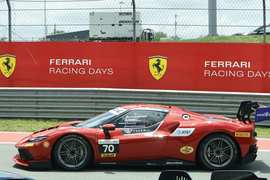
If you want to understand how far manufacturers will go to provide an authentic racing experience, look no further than the Ferrari F50. Its 4.7-liter naturally aspirated V12 was a direct descendant of the Tipo 641, the car piloted by Alain Prost. With an 8,500 RPM redline and a rigid, carbon-fiber chassis that bolted the engine directly to the tub, the F50 is widely considered the closest a civilian has ever come to driving an authentic Formula 1 car on public highways.
Ford GT (2005 & 2017): Le Mans Heritage
The Ford GT is the modern standard-bearer for Le Mans-winning technology. The 2005 model utilized a supercharged 5.4-liter V8 born from endurance racing development. Its successor, the 2017 GT, shifted to a 3.5-liter twin-turbo EcoBoost V6, mirroring the powerplant that propelled Ford’s GTE program to victory. These vehicles aren’t just tributes; they are functional manifestations of Ford’s global racing strategy.
Jaguar XJ220: The Group C Survivor
The XJ220 is a testament to what happens when pure racing engineering meets a production deadline. Featuring a 3.5-liter twin-turbo V6 derived from the Jaguar XJR-11 Group C racer, this machine was once the fastest production car on the planet. Its engine, designed for the rigors of high-speed endurance, gave the XJ220 a clinical, turbocharged efficiency that was light-years ahead of the competition.
Plymouth Belvedere: The NASCAR Hemi
The 426 “Race Hemi” is arguably the most famous engine in the history of American stock car racing. When Plymouth dropped this NASCAR-developed beast into the 1964 Belvedere, it created a street-legal terror. With 425 hp and an aggressive power band, it brought the dominance of oval-track racing to the stoplight-to-stoplight reality of American streets.
Porsche 918 Spyder: Hybrid Endurance
The 918 Spyder represents the future of motorsport DNA. Its 4.6-liter V8 is a descendant of the RS Spyder, which conquered the LMP2 class at Le Mans. By integrating this naturally aspirated masterpiece with high-torque electric motors, Porsche created a vehicle that combines 887 hp with the emotional roar of a high-revving racing engine, achieving a 0-60 sprint of roughly 2.2 seconds.
Porsche Carrera GT: The Analog Pinnacle
The Carrera GT remains the ultimate analog experience. Its 5.7-liter V10 was originally slated for a Formula 1 program, later repurposed for an endurance prototype, and eventually installed in this flagship supercar. With no driver aids to mask the engine’s 8,000 RPM intensity, it is a demanding, rewarding, and historically significant piece of machinery that serves as a monument to Porsche’s engineering prowess.
Conclusion: Your Gateway to the Track
Investing in a car with genuine racing heritage is more than just a financial decision—it’s an investment in automotive history. These machines serve as a bridge between the sterile precision of the racetrack and the unpredictable beauty of the open road. Whether you are seeking the raw power of a V12 or the balanced precision of a race-bred V6, there has never been a better time to explore the market for high-performance exotics.
Are you ready to elevate your driving experience with a vehicle that truly pushes the limits of engineering? Explore our latest inventory of high-performance and motorsport-inspired vehicles today, and let us help you find the machine that captures your passion for speed. Contact our specialist team to schedule your private consultation.