
Engineering the Edge: 10 Legendary Production Cars with Pure Motorsport DNA
There is an undeniable, visceral thrill that comes from piloting a vehicle engineered with true motorsport DNA. As someone who has spent a decade navigating the automotive industry—from factory floors to the white-knuckle intensity of track-day events—I can tell you that there is a profound difference between a car styled to look fast and one born from the crucible of competitive racing. We aren’t just talking about aesthetic spoilers or stiff suspension tuning; we are talking about street-legal machines powered by engines originally forged in the fires of top-tier professional competition.

These power plants bring high-revving, race-bred performance to public roads, offering a tangible connection to the legendary circuits that inspired them. When you press the pedal in a vehicle that shares its heart with a prototype, you aren’t just driving; you are participating in a lineage of engineering excellence.
The Symbiotic Relationship: Motorsport and Road Innovation
The intersection of motorsport and road-going performance is where automotive history is written. Racing serves as the ultimate R&D laboratory, where components are pushed to the absolute edge of failure. In this unforgiving environment, engineers discover the limits of metallurgy, thermodynamics, and fluid dynamics. Consequently, technologies that define modern high-performance vehicles—such as carbon-ceramic braking systems, dual-clutch transmissions, and advanced active aerodynamics—originated as racing necessities before finding their way into the showroom.
Investing in motorsport is a high-stakes play for automakers. While the cost is astronomical, the return on brand equity is invaluable. A manufacturer that dominates on the track inevitably gains a reputation for engineering authority. For the enthusiast, this means that even if we aren’t professional drivers, we can experience the adrenaline of race-derived power. Let’s explore ten iconic production vehicles that blur the lines between a Sunday drive and a track-day masterclass.
Alfa Romeo Montreal: A Prototype in Disguise
The Alfa Romeo Montreal is a masterclass in understated intensity. Under its striking hood lies a 2.6-liter V8 derived directly from the Tipo 33 sports prototype—a machine that battled in the Targa Florio and the 24 Hours of Daytona. While the road-going Montreal was detuned for drivability, the core architecture remained. It possesses an engine capable of singing to 7,000 RPM, delivering 200 horsepower that feels far more potent thanks to the car’s balanced chassis.
BMW M1, M5, and M6: The M-Division Revolution
BMW’s motorsport heritage is synonymous with the M badge, but it truly began with the M88 inline-six. Developed for the M1 ProCar series, this engine was a race-bred masterpiece. BMW didn’t leave this technology in the pits; they adapted the M88 for the E28 M5 and E24 M6, effectively creating the super-sedan segment. Furthermore, the E30 M3’s legendary S14 engine pulled from the M12 F1 power plant, cementing BMW’s dominance in DTM touring car racing.
Chevrolet Camaro ZL1 (1969): The Can-Am Muscle
In the late 60s, the SCCA Trans-Am and Can-Am series were the apex of American racing. Chevrolet responded with the 1969 Camaro ZL1, utilizing a 7.0-liter all-aluminum V8 originally designed for Can-Am glory. While rated at 430 horsepower for the public, these engines were famously capable of much more. With only 69 units produced, it remains one of the most sought-after collector items for those who value authentic racing lineage.
Ferrari Dino 206 GT: The Mid-Engine Pioneer
Named in honor of Enzo Ferrari’s son, the Dino 206 GT introduced the world to Ferrari’s mastery of the small-displacement V6. This engine was born in the competitive world of 1960s Formula 2 racing. Despite its modest 2.0-liter displacement, the car’s featherlight construction and high-revving nature turned it into a corner-carving icon. It set the blueprint for every mid-engine supercar that followed from the Italian marque.
Ferrari F50: The Closest Thing to F1
The F50 is not merely a sports car; it is a Formula 1 car wearing a body shell. To celebrate its 50th anniversary, Ferrari pulled the V12 engine from the 1990 Tipo 641 F1 car, driven by the likes of Alain Prost. This naturally aspirated 4.7-liter monster revs to 8,500 RPM, producing a soundtrack that is nothing short of operatic. It offers an unfiltered, raw driving experience that modern, electronic-heavy supercars struggle to replicate.
Ford GT: From Le Mans to the Driveway
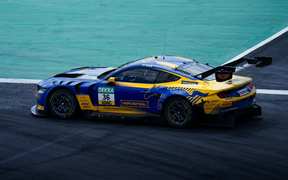
The Ford GT story is a tribute to the legendary GT40. The 2005 Ford GT utilized a supercharged 5.4-liter V8 rooted in Ford’s endurance racing prototype program. A decade later, the 2017 Ford GT pushed the envelope further with a twin-turbo 3.5-liter EcoBoost V6—a direct descendant of the engines Ford used to conquer the GTE Pro class at Le Mans. It represents the pinnacle of modern, forced-induction racing efficiency.
Jaguar XJ220: The Group C Survivor
The XJ220 holds a special place in my heart as one of the most misunderstood masterpieces of the 90s. Initially designed for a V12, the production model famously adopted the twin-turbo 3.5-liter V6 from the Jaguar XJR-11 Group C racer. This transplant was a stroke of genius, enabling the XJ220 to hold the title of the world’s fastest production car for years. It remains a raw, analog beast that demands respect from its driver.
Plymouth Belvedere: The NASCAR Legend
It is easy to forget that the 1964 Plymouth Belvedere was a vessel for the 426 Hemi V8—the “Race Hemi.” Developed specifically for the brutal, high-speed banking of NASCAR, this engine was the most feared power plant of its era. Bringing that level of NASCAR performance to a street-legal coupe changed the muscle car industry forever, creating a legend that would influence drag racing for decades to come.
Porsche 918 Spyder: The Hybrid Titan
When we discuss the integration of electric performance, the 918 Spyder is the benchmark. Porsche based its 4.6-liter V8 on the RS Spyder, the LMP2 endurance race winner. By mating this track-hardened engine with sophisticated electric motors, Porsche created a vehicle that defies physics. It is a testament to how racing hybrid technology can provide both efficiency and staggering, 0-60 in 2.2-second performance.
Porsche Carrera GT: The Analog Zenith
The Carrera GT is arguably the finest driver’s car of the early 2000s. Its 5.7-liter V10 was a product of a cancelled F1 program and a subsequently shelved Le Mans prototype. Porsche decided that such a glorious, high-revving engine deserved to be driven on the road. The result is a visceral, manual-transmission supercar that remains the ultimate “bucket list” car for any serious automotive enthusiast.
The Expert Perspective: Why It Matters
As we move toward a future of electrification, the importance of “motorsport DNA” is shifting, but the core principle remains the same. The best cars are those where the engineers were told to win, not just to sell. Whether you are looking for high-revving atmospheric V10s or high-torque, turbocharged V6s, these vehicles offer more than just specs on paper—they offer a soul forged on the track.
If you are currently looking to add a piece of racing history to your own garage or simply want to experience the peak of automotive performance, the journey begins with understanding what lies beneath the bodywork. The market for these performance-oriented machines is more dynamic than ever; staying informed is the best way to ensure you make the right investment.
Are you ready to elevate your driving experience? Contact our specialist team today for an in-depth consultation on finding your perfect performance machine, or subscribe to our newsletter for exclusive insights into the latest market trends and collector-grade vehicle availability.