
The Heart of a Champion: 10 Street-Legal Production Vehicles with Race-Bred Engines
There is a visceral, unmistakable thrill that comes from gripping the wheel of a machine infused with genuine motorsport DNA. We aren’t simply discussing aesthetic carbon fiber trim or aggressive “track-inspired” body kits. We are talking about the rare breed of production vehicles that house actual power plants forged in the crucible of professional racing. These engines, born from the relentless demands of endurance circuits and Formula 1 grids, bring a high-revving, adrenaline-soaked character to public roads that a standard commuter car could never replicate.
In the modern automotive landscape of 2025, where electrification and synthetic driving feels are becoming the norm, these mechanical masterpieces represent the pinnacle of internal combustion. They offer a direct, unfiltered conduit to the legendary race cars that paved their way. From screaming naturally aspirated V12s to high-pressure turbocharged units, these vehicles blur the boundary between the paddock and the driveway.
The Engineering Philosophy: From the Podium to the Pavement
The relationship between motorsport and road cars has served as the backbone of automotive innovation for over a century. Racing is the ultimate laboratory; it is a high-stakes environment where engineers push metallurgy, fluid dynamics, and electronics to the breaking point. If a component can survive the 24 Hours of Le Mans or the brutal vibrations of a Grand Prix, it can certainly handle the highway.
This “trickle-down” technology is more than just marketing fluff. Innovations like carbon-ceramic brakes, dual-clutch transmissions, and active aerodynamics all moved from the circuit to the showroom. However, the most coveted transfer of technology remains the engine. For manufacturers, the investment in motorsport serves two purposes: it accelerates technical development and cements brand prestige. The “Win on Sunday, Sell on Monday” mantra remains a high-value strategy for luxury marques looking to justify their premium pricing.
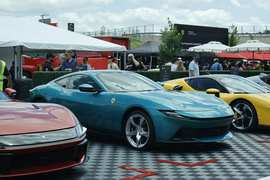
When you purchase a car with a race-bred engine, you aren’t just buying a mode of transportation; you are acquiring a piece of engineering history. Here are 10 legendary machines that prove racing tech belongs on the street.
Alfa Romeo Montreal: The Endurance Hero
The Alfa Romeo Montreal is a masterclass in Italian style, but its true beauty lies beneath the vented hood. It features a 2.6-liter V8 derived directly from the Tipo 33 sports prototype—a car that carved its name into history at the Targa Florio and Daytona.
While the engineers detuned the unit to make it more manageable for a “Grand Tourer” role, it maintained its race-car soul. Revving to a glorious 7,000 RPM, it produced 200 horsepower—a massive figure for its era. The Montreal remains one of the most charismatic examples of how a high-performance engine can transform a beautiful coupe into a legitimate collector’s item.
BMW M1 and the Legacy of the M88
BMW’s M Division is synonymous with high-performance vehicle parts, but the M1 was the spark that lit the fire. The M1 utilized the M88 inline-six, a 3.5-liter engine developed specifically for the ProCar BMW M1 championship.
The brilliance of this engine was its versatility. After proving its reliability on the track, a modified version found its way into the E24 M6 and the original E28 M5, effectively creating the sport-sedan segment. Not to be outdone, the iconic E30 M3 utilized the S14 four-cylinder, which was essentially a truncated version of that same M88 race block. If you want to talk about automotive performance upgrades that changed the world, the M88 is the gold standard.
1969 Chevrolet Camaro ZL1: The Can-Am Connection
In the world of American muscle, the 1969 ZL1 is a unicorn. Chevrolet took a 427-cubic-inch (7.0-liter) V8 designed for Can-Am racing and stuffed it into a production Camaro. This was an all-aluminum beast—an exotic material choice at the time—which kept the front end light and the power-to-weight ratio terrifying.
While officially rated at 430 hp to satisfy insurance companies, most tuners knew it was pushing north of 500 hp. Only 69 units were ever produced, making it a “blue-chip” asset in exotic car sales today. It wasn’t just a car; it was a street-legal dragster that utilized motorsport DNA to dominate the stoplight grand prix.
Ferrari Dino 206 GT: The Formula 2 Heart
Named after Enzo Ferrari’s son, the Dino 206 GT was a pivotal moment for the Maranello-based brand. It featured a 2.0-liter V6 that was originally drafted for Ferrari’s Formula 2 cars in the mid-1960s.
This engine was remarkably light and rev-happy, producing 180 hp. Because the Dino was a featherweight at just over 2,000 pounds, the racing engine provided a level of agility and response that few V12s could match at the time. It set the blueprint for every mid-engine V6 and V8 Ferrari that followed, proving that a smaller displacement, race-tuned engine could deliver world-class luxury car performance.
Ferrari F50: An F1 Car for the Boulevard
If the Dino was a subtle nod to racing, the Ferrari F50 was a loud, unapologetic scream. To celebrate their 50th anniversary, Ferrari decided to build a road car around their 1990 Formula 1 engine.
The Tipo F130B 4.7-liter V12 was bolted directly to the chassis as a stressed member—just like in Alain Prost’s F1 seat. With an 8,500 RPM redline and 513 hp, the F50 offered a raw, vibrating experience that modern supercars often lack. It remains the closest the public has ever come to owning a street-legal Grand Prix car from the golden era of V12s.
Ford GT: From Le Mans to the Local Meet
The Ford GT is a nameplate defined by the quest to beat Ferrari at Le Mans. The 2005 revival utilized a 5.4-liter supercharged V8 that shared its architecture with Ford’s Daytona Prototype engines.

The 2017 second-generation GT went even further, ditching the V8 for a 3.5-liter twin-turbo EcoBoost V6. This wasn’t just a “truck engine” as some critics claimed; it was the exact power plant developed for the Ford GT Le Mans racer that won its class in 2016. These cars represent a masterclass in aerodynamic design and endurance-proven reliability, making them highly sought after in luxury car financing circles.
Jaguar XJ220: The Group C Survivor
The Jaguar XJ220 was once the fastest production car on Earth, reaching 217 mph. While the world expected a V12, Jaguar delivered something perhaps more potent: a 3.5-liter twin-turbo V6 lifted straight from the Jaguar XJR-11 Group C racer.
This engine provided the XJ220 with a massive 542 hp and a brutal power delivery that felt more like a fighter jet than a car. Despite the initial controversy over its cylinder count, the XJ220’s racing heart proved that turbocharged technology from the track could redefine the supercar landscape.
1964 Plymouth Belvedere: The NASCAR “Elephant”
The Plymouth Belvedere might look like a standard family sedan of the 60s, but it housed a monster: the 426 Hemi V8. This engine was engineered specifically to dominate the high banks of NASCAR.
Known as the “Race Hemi,” it was so successful that it was briefly banned from competition until Plymouth made it available in production vehicles for the general public. The street version delivered 425 hp and nearly 500 lb-ft of torque, earning it the nickname “The Elephant.” It is a prime example of how racing regulations can force a manufacturer to put their best technology in the hands of the consumer.
Porsche 918 Spyder: Hybridization Perfected
The Porsche 918 Spyder proved that the future of motorsport DNA involves electricity. At its core is a 4.6-liter naturally aspirated V8 that traces its lineage to the RS Spyder LMP2 car.
When combined with two electric motors, the system produces 887 hp and 944 lb-ft of torque. The result is a 0-60 mph time of just 2.2 seconds. While the hybrid system is the brain, the high-revving V8 is the soul, providing the auditory drama that only a race-proven engine can deliver. For those looking for high-performance vehicle insurance for a car that can do it all, the 918 remains the benchmark for the “Holy Trinity” of hypercars.
Porsche Carrera GT: The Formula 1 Orphan
Many enthusiasts consider the Porsche Carrera GT the greatest supercar of all time. Its heart is a 5.7-liter V10 that was originally intended for a Footwork Formula 1 car in the early 90s. When that project fell through, the engine was adapted for a Le Mans prototype, which was also shelved.
Ultimately, Porsche decided to give this “homeless” race engine a body—the Carrera GT. With 603 hp and a sound that mimics a screaming F1 grid, the Carrera GT is a visceral, analog masterpiece. It is widely considered one of the most challenging and rewarding cars to drive, largely because its engine refuses to forget its racing pedigree.
Why Racing Technology Matters in 2025
As we navigate an era of autonomous features and engine downsizing, the presence of motorsport-derived technology in a car is a badge of honor. It signifies that a manufacturer isn’t just selling a product; they are selling a legacy of competition and engineering excellence. These cars hold their value better than almost any other asset class in the automotive market, serving as both a thrill ride and a sound investment.
Whether it’s the roar of a V12 or the whistle of a high-pressure turbo, these engines remind us why we fell in love with driving in the first place. They are the ultimate expression of human ingenuity, proving that the lessons learned at 200 mph on a Saturday can make a Monday morning drive feel like a trip to the podium.

Are you ready to experience the raw power and precision of a vehicle engineered for the track? Contact our expert consultants today to explore our exclusive inventory of race-bred machines and find the perfect addition to your collection.