
From Track to Tarmac: 10 Street-Legal Monsters with Race-Bred Engines
There is a visceral, unmistakable thrill that comes with piloting a vehicle engineered with pure motorsport DNA. We aren’t simply discussing aesthetic carbon fiber trim or aggressive aero kits; we are highlighting the engineering marvels that house race-bred engines originally forged for the podium. These high-performance machines bridge the gap between the circuit and the cul-de-sac, offering a high-revving, adrenaline-fueled experience that most drivers only dream of.
For enthusiasts looking to buy performance cars with a legitimate pedigree, the allure of a track-ready engine in a street-legal chassis is the ultimate benchmark. In this deep dive, we explore 10 production vehicles that blur the lines of reality, delivering the soul of a race car to public roads. But before we reveal the list, it is essential to understand why manufacturers invest billions into racing and how that “trickle-down” technology enhances the automotive performance of the car sitting in your garage.
The Engineering Pipeline: Why Motorsport DNA Matters
The relationship between the racetrack and the showroom is a storied tradition in the automotive world. Racing serves as the ultimate laboratory—a high-stress environment where components are pushed to the absolute breaking point. What engineers discover at 200 mph under the grueling heat of an endurance race directly informs the reliability and efficiency of modern production vehicles.
From the early adoption of disc brakes to the lightning-fast shifts of modern dual-clutch transmissions, the innovations we take for granted today were born in the heat of competition. Furthermore, the “Win on Sunday, Sell on Monday” philosophy remains a cornerstone of brand authority. When a manufacturer dominates a series like Le Mans or Formula 1, it validates their engineering prowess, making their road-going fleet more desirable to collectors and performance junkies alike.
Alfa Romeo Montreal: The Endurance Prototype Hero
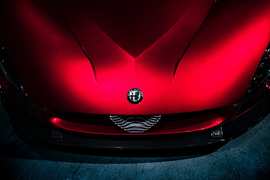
The Alfa Romeo Montreal is a masterclass in 1970s style, but its true heart lies beneath the hood. It features a 2.6-liter V8 derived directly from the Alfa Tipo 33 sports prototype—a legendary machine that tackled the Targa Florio and the 24 Hours of Daytona.
While the Montreal was tuned for the street, it retained its high-revving racing character, screaming up to a 7,000 RPM redline. Producing 200 horsepower, this V8 provided a symphonic exhaust note that few modern cars can replicate. For those seeking classic car investments, the Montreal remains a hidden gem with genuine motorsport DNA.
BMW M-Series Icons: The M88 and S14 Legacy
BMW’s “M” division is synonymous with track-ready performance. The legendary BMW M1 utilized the M88 inline-six, a 3.5-liter powerhouse born for the M1 ProCar series. This same engine architecture eventually found its way into the E24 M6 and the original E28 M5, effectively birthing the “super sedan” category.
Equally impressive is the E30 M3. Its S14 four-cylinder engine was essentially a shortened version of the M1’s powerplant, incorporating technology from BMW’s turbocharged F1 programs. Designed to dominate DTM touring car racing, the S14 turned the E30 M3 into one of the most successful road-to-race transitions in history.
1969 Chevrolet Camaro ZL1: The Drag Strip King
When it comes to raw American muscle, the 1969 Chevrolet Camaro ZL1 stands alone. At its core was an all-aluminum 427 cubic-inch (7.0-liter) V8 designed specifically for Can-Am racing. The use of aluminum was revolutionary for the time, drastically reducing front-end weight and improving handling.
Although officially rated at 430 hp to appease insurance companies, these engines frequently dynoed at over 500 hp. With only 69 units ever produced, the ZL1 is a pinnacle of collector car auctions, representing a moment when a full-blown race engine was dropped into a pony car for the masses.
Ferrari Dino 206 GT: The Formula 2 Connection
The Ferrari Dino 206 GT was a tribute to Enzo Ferrari’s son, Alfredo “Dino” Ferrari, who helped develop the V6 engine layout. This 2.0-liter V6 was originally intended for Formula 2 racing in the 1960s.
Despite being “the small Ferrari,” the 206 GT offered a purity of balance and a high-revving 180 hp output that made it a surgical tool on winding roads. It was the first mid-engine production car from Maranello, proving that a race-bred engine doesn’t need twelve cylinders to deliver a world-class driving experience.
Ferrari F50: An F1 Car for the Street
If the Dino was a subtle nod to racing, the Ferrari F50 was a loud, unfiltered shout. To celebrate its 50th anniversary, Ferrari took the 3.5-liter V12 from the 1990 Ferrari 641 Formula 1 car (driven by Alain Prost), enlarged it to 4.7 liters, and bolted it directly to the chassis.
The Tipo F130B engine produces 513 hp and screams to an 8,500 RPM redline. Because the engine is a stressed member of the chassis—just like in an F1 car—the vibrations and sounds are transmitted directly to the driver. It remains one of the most raw and visceral exotic cars ever manufactured.
Ford GT: Le Mans Pedigree Reimagined
The Ford GT exists for one reason: to honor the legacy of the GT40’s dominance at Le Mans. The 2005 iteration used a 5.4-liter supercharged V8 that shared architecture with Ford’s Daytona Prototype engines.
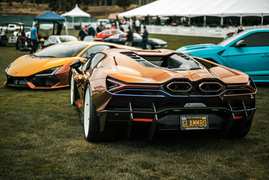
The 2017 second-generation Ford GT took things further by utilizing a 3.5-liter twin-turbo EcoBoost V6. This engine was developed in tandem with the CGR (Chip Ganassi Racing) endurance program. By the time the road car reached customers, the engine had already won its class at the 24 Hours of Le Mans, proving that modern turbocharged performance can indeed carry a racing soul.
Jaguar XJ220: The Group C Speed King
The Jaguar XJ220 remains one of the most polarizing yet impressive supercars of the 1990s. While fans initially clamored for a V12, Jaguar delivered something even more potent: a 3.5-liter twin-turbo V6 lifted straight from the Jaguar XJR-11 Group C racer.
This engine propelled the XJ220 to a top speed of 217 mph, making it the fastest production vehicle in the world at the time. Its racing pedigree ensured that while it lacked four cylinders, it possessed a level of automotive engineering and top-end speed that few could match.
Plymouth Belvedere: The “Race Hemi” Dominator
In 1964, the Plymouth Belvedere became the vessel for the most feared engine in NASCAR: the 426 Hemi V8. Known simply as the “Race Hemi,” it was so dominant on the oval tracks that NASCAR briefly banned it until Plymouth made it available in production cars.
The street-legal version, producing a “conservative” 425 hp, cemented the Hemi’s legacy in American culture. For those interested in muscle car restoration, finding an original Hemi Belvedere is like discovering the Holy Grail of motorsport DNA.
Porsche 918 Spyder: The Hybrid Revolution
The Porsche 918 Spyder proved that the future of racing—and the street—is electric. However, the heart of this hypercar is a 4.6-liter naturally aspirated V8 based on the unit found in the Porsche RS Spyder LMP2 race car.
By pairing this race-bred engine with two electric motors, Porsche achieved a combined output of 887 hp and a 0-60 mph time of just 2.2 seconds. This vehicle represents the pinnacle of hybrid performance, showing how track technology can adapt to the modern era without losing its emotional soul.
Porsche Carrera GT: The Shelved F1 Masterpiece
The Porsche Carrera GT is widely considered the greatest analog supercar of all time. Its 5.7-liter V10 was originally designed for a Footwork Formula 1 program in the early 90s. When that fell through, it was repurposed for a Le Mans prototype that was also eventually canceled.
Refusing to let such a masterpiece go to waste, Porsche built the Carrera GT around it. The result is a 603 hp engine with a cry that sounds like a vintage F1 grid. With no electronic stability control and a ceramic clutch, it is a demanding, pure, and unapologetic tribute to motorsport engineering.
Experience the Legacy of Performance
Owning a vehicle with a race-bred engine is more than just a status symbol; it is an invitation to experience automotive history. Whether you are looking for a high-performance daily driver or a weekend track toy, the influence of motorsport ensures your vehicle is built to a higher standard of speed and durability.
Are you ready to elevate your driving experience to the next level? Contact our specialist team today to explore our exclusive inventory of performance vehicles and find the perfect machine to ignite your passion for the road.