
The Racing Pulse: 10 Iconic Street Cars with High-Performance Engines Born on the Track
There is an undeniable, visceral thrill that comes from piloting a machine infused with authentic motorsport DNA. We aren’t talking about superficial aesthetic packages or “track-inspired” trim levels that offer more show than go. We are discussing the elite echelon of engineering—road-legal vehicles that house power plants originally forged for the uncompromising world of professional racing. These high-revving, adrenaline-surging hearts were built to withstand the brutal pressures of endurance racing and the high-stakes sprints of Formula 1, ultimately finding their way into production chassis to offer enthusiasts a direct, unfiltered connection to the podium.
As an industry veteran with over a decade spent evaluating high-performance vehicles, I’ve seen how the “Win on Sunday, Sell on Monday” philosophy has evolved. In 2025, the gap between a luxury sports car and a dedicated track weapon is narrower than ever, thanks to the relentless pursuit of thermal efficiency and lightweight metallurgy. Today, we’re dissecting 10 legendary production vehicles that successfully blurred the lines, delivering the raw essence of a race car to the public pavement.
The Engineering Bridge: Why Motorsport Technology Matters
The synergy between the circuit and the cul-de-sac is the primary driver of automotive innovation. Racing serves as a high-pressure laboratory where engineers test components to the point of catastrophic failure. When a part survives 24 hours at Le Mans, it’s over-engineered for a lifetime of spirited street driving. This automotive engineering trickle-down effect is responsible for nearly every modern safety and performance feature we take for granted.
From the ubiquity of carbon-ceramic brakes to the lightning-fast shifts of modern dual-clutch transmissions, the track is the ultimate proving ground. Beyond the hardware, motorsport success builds a “halo effect” for manufacturers. If a brand dominates the DTM or WEC, their performance vehicles gain an aura of invincibility. For the discerning collector or the weekend canyon carver, owning a car with a race-bred engine isn’t just about the 0-60 mph time; it’s about the soul of the machine.
Alfa Romeo Montreal: The Endurance Prototype Heart
The Alfa Romeo Montreal is a masterclass in 1970s style, but its true beauty lies beneath the hood. It features a 2.6-liter V8 derived directly from the Tipo 33, an endurance racer that achieved glory at the Targa Florio and the 24 Hours of Daytona.
| Engine Specs | Tipo 33 Derived V8 |
| :— | :— |
| Displacement | 2.6-liter |
| Output | 200 hp / 173 lb-ft |

| Rev Limit | 7,000 RPM |
While the engineers detuned the unit for better street manners, it retained its high-strung personality. The Montreal offered a sophisticated mechanical fuel injection system and a dry-sump lubrication setup—features typically reserved for exotic cars of that era. It remains one of the most charismatic examples of Italian racing technology scaled for the road.
BMW M-Series Icons: From ProCar to the Driveway
BMW’s “M” division is perhaps the most famous practitioner of the race-to-road philosophy. The story begins with the BMW M1, which utilized the M88 inline-six engine designed for the M1 ProCar championship. This engine was so potent and reliable that BMW decided to drop it into the E28 M5 and the E24 M6, effectively creating the “Executive Express” segment.
Not to be outdone, the E30 M3 utilized the S14 four-cylinder engine. This wasn’t just a modified street engine; it was essentially the M88 with two cylinders lopped off, sharing a head design with BMW’s turbocharged F1 engines. If you are looking for a vintage car investment, these M-powered legends continue to appreciate because their mechanical purity is rooted in DTM touring car dominance.
1969 Chevrolet Camaro ZL1: The Can-Am Connection
In the world of American muscle, the 1969 Camaro ZL1 is the “Holy Grail.” Its heart was an all-aluminum 427 cubic-inch (7.0-liter) V8 designed specifically for the Can-Am racing series. At a time when cast iron was king, this lightweight, high-displacement monster provided an unrivaled power-to-weight ratio.
Official Rating: 430 hp (notoriously underrated)
Actual Output: Closer to 500 hp
Production: Only 69 units
The ZL1 turned the Camaro from a pony car into a street-legal drag racer. Because the engine was so expensive—costing more than a base Camaro itself—it remains a pinnacle of classic car auctions and a testament to Chevy’s “under-the-table” racing support during the 1960s.
Ferrari Dino 206 GT: The Formula 2 Legacy
Named after Enzo Ferrari’s son, the Dino 206 GT was a pivotal moment for the Maranello-based manufacturer. Its 2.0-liter V6 was a direct descendant of the engines used in Ferrari’s Formula 2 efforts.
Though it produced a modest 180 hp, the car’s 2,000-pound curb weight meant it possessed an agility that larger V12 Ferraris couldn’t match. It was the first mid-engine production car from the brand, proving that high-performance tuning and a race-bred V6 could provide a world-class driving experience without twelve cylinders.
Ferrari F50: An F1 Car in a Tuxedo
If the Dino was a subtle nod to racing, the Ferrari F50 was a megaphone-shouted declaration. Created for the brand’s 50th anniversary, the F50 used the Tipo F130B V12, which was a 4.7-liter evolution of the 3.5-liter V12 found in Alain Prost’s 1990 Formula 1 car (the F1-90).
“The F50 is the closest a driver can get to the Formula 1 experience while still having a license plate. The engine is bolted directly to the chassis, acting as a stressed member, just like in a Grand Prix car.”
With a spine-tingling 8,500 RPM redline and 513 hp, the F50 provides a mechanical connection that modern supercars often mask with electronic aids.
Ford GT: The Le Mans Resurrection
The Ford GT is a nameplate synonymous with endurance excellence. The 2005 iteration utilized a 5.4-liter supercharged V8 that shared architecture with Ford’s Daytona Prototype engines. Fast forward to 2017, and Ford doubled down on motorsport DNA by using a 3.5-liter Twin-Turbo EcoBoost V6.
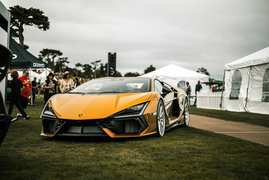
This V6 wasn’t just “inspired” by racing; the engine was developed simultaneously for the road car and the Chip Ganassi Racing Ford GT that won its class at Le Mans in 2016. It’s a masterclass in turbocharged performance and aerodynamic integration.
Jaguar XJ220: The Group C Speed King
The Jaguar XJ220 is often remembered for what it wasn’t (a V12), but enthusiasts recognize it for what it truly was: a land-bound missile. It utilized a 3.5-liter twin-turbocharged V6 taken straight from the Jaguar XJR-11 Group C race car.
By leveraging aerodynamic downforce and 542 hp, the XJ220 hit a top speed of 217 mph, holding the title of the world’s fastest production car for a period. Its engine remains one of the most advanced examples of race-proven technology being adapted for high-speed grand touring.
Plymouth Belvedere: The NASCAR “Race Hemi”
In 1964, Plymouth unleashed the 426 Hemi V8 within the Belvedere. This engine was developed for one purpose: to dominate NASCAR. It was so successful that it was briefly banned until Plymouth made enough “street” versions to satisfy homologation rules.
With 425 hp and a massive 490 lb-ft of torque, the Belvedere became a terror on the street. This engine established the Hemi as a household name and cemented the “Mopar” legacy in the pantheon of American muscle cars.
Porsche 918 Spyder: The Hybrid Pioneer
The Porsche 918 Spyder redefined the hypercar category by proving that electrification could enhance, rather than dull, the racing experience. Its 4.6-liter V8 is an evolution of the engine found in the RS Spyder LMP2 prototype.
| Performance Metric | Porsche 918 Spyder |
| :— | :— |
| Combined Power | 887 hp |
| Combined Torque | 944 lb-ft |
| 0-60 mph | 2.2 Seconds |
The 918 uses its electric motors for instant torque, but the screaming, high-exit exhaust V8 provides the soul. It represents the pinnacle of hybrid vehicle technology where track-proven reliability meets futuristic efficiency.
Porsche Carrera GT: The Shelved F1 Masterpiece
Widely considered the greatest “analogue” supercar ever produced, the Porsche Carrera GT features a 5.7-liter V10 with a fascinating backstory. The engine was originally a secret project for Formula 1 in the early 90s. When that project was cancelled, the engine was resized for a Le Mans prototype, which was also shelved.
Finally, Porsche decided to place this V10 into a production flagship. The result is a car that produces 612 hp with a sound often compared to a screaming banshee. With a carbon fiber monocoque and a ceramic clutch, the Carrera GT is a pure, unfiltered race car for the street that demands respect from its driver.
The Future of Track-to-Road Technology
As we look toward the 2026 season and beyond, the definition of motorsport DNA is shifting. We are seeing more integration of MGU-H and MGU-K hybrid systems from Formula 1 into daily-driven luxury vehicles. Brands like Mercedes-AMG with the One and Aston Martin with the Valkyrie are pushing the envelope of what is legally allowed on public roads.
However, the ten cars listed above represent a unique era where mechanical engineering was the primary focus. They offer a level of engagement that is becoming increasingly rare in an era of digital steering and autonomous assists. For those who prioritize the “feeling” of the drive, there is simply no substitute for a car with a heart born on the starting grid.
Are you ready to experience the raw power of a race-bred engine for yourself? Whether you are looking to acquire a modern hypercar or a classic muscle legend, understanding the racing lineage of your vehicle is the first step toward true automotive appreciation. Contact our team of performance consultants today to find the perfect track-ready machine for your collection.