
From Paddock to Pavement: 10 Elite Production Vehicles with Genuine Motorsport DNA
There is an electrifying sensation that comes with piloting a machine infused with motorsport DNA. We aren’t merely discussing carbon fiber trim or aggressive aero kits; we are talking about the mechanical soul of a vehicle—the race-bred engines that were originally forged for the podium and later transplanted into street-legal chassis. These high-performance power units, tempered in the crucible of professional competition, offer enthusiasts a visceral, high-revving connection to the world of professional racing.
In this deep dive, we explore 10 legendary production vehicles that blur the line between a weekend track toy and a daily commuter. From the piercing scream of naturally aspirated V12s to the relentless torque of turbocharged endurance motors, these vehicles represent the pinnacle of automotive engineering. As we move into 2025, the “Win on Sunday, Sell on Monday” philosophy is experiencing a massive resurgence, and for those looking to invest in classic cars or high-performance exotics, understanding the racing lineage of these vehicles is paramount.
The Engineering Bridge: Why Motorsport DNA Matters
The relationship between the race track and the showroom floor is a century-old tradition. Racing serves as a high-stakes laboratory where engineers push metallurgy, fluid dynamics, and thermodynamics to their absolute breaking point. When a component survives the 24 Hours of Le Mans or a grueling Formula 1 season, that technology eventually “trickles down” to consumer vehicles.
Innovation born from motorsport DNA has gifted us with modern essentials: disc brakes, dual-clutch transmissions, and sophisticated active aerodynamics. Beyond the technology, racing dominance builds brand equity. When a manufacturer conquers the track, its road cars inherit an aura of reliability and prestige. While few will ever sit in the cockpit of a modern prototype, owning a car with a race-bred engine allows a driver to experience a fragment of that glory.
Alfa Romeo Montreal: The De-Tuned Endurance King

The Alfa Romeo Montreal is a masterclass in 1970s aesthetics, but its true beauty lies beneath the hood. It houses a 2.6-liter V8 engine directly derived from the legendary Tipo 33 sports prototype. The Tipo 33 was a dominant force in endurance racing, claiming victories at the Targa Florio and Daytona.
While Alfa Romeo engineers de-tuned the high-strung racing unit for better street manners, the Montreal retained its screaming character. Capable of hitting 7,000 RPM and producing 200 horsepower, this V8 provided a soundtrack that few contemporary grand tourers could match. For collectors looking for high-value vintage Alfas, the Montreal remains an underrated gem with a pure racing heart.
BMW M-Division Icons: M1, E30 M3, and the E28 M5
BMW’s “M” badge is perhaps the most famous symbol of motorsport DNA in the world. It started with the BMW M1, which utilized the M88 inline-six engine—a unit specifically developed for the M1 ProCar series. This same engine architecture later found its way into the E24 M6 and the first-ever E28 M5, effectively birthing the “super sedan” segment.
Equally legendary is the E30 M3. Its S14 four-cylinder engine was essentially a shortened version of the M1’s inline-six, utilizing the same cylinder head geometry. Built to satisfy DTM (German Touring Car) homologation rules, the E30 M3 wasn’t just inspired by racing; it was a race car sold in showrooms. Today, the market value of E30 M3s continues to skyrocket as purists seek out that authentic DTM feeling.
Chevrolet Camaro ZL1 (1969): The All-Aluminum Drag Beast
In the late 60s, Chevrolet unleashed a monster: the 1969 Camaro ZL1. At its core was a 427 cubic-inch (7.0-liter) V8 designed for the high-intensity Can-Am racing series. What made this engine special was its all-aluminum construction, which significantly reduced front-end weight compared to standard cast-iron big blocks.
Officially rated at 430 hp to appease insurance companies, the actual output was closer to 500 hp. This engine was a staple of the SCCA Trans-Am series and turned the Camaro into a street-legal drag strip king. With only 69 units produced, the 1969 ZL1 is one of the rarest muscle cars in existence, commanding seven-figure prices at major auctions.
Ferrari Dino 206 GT: The Formula 2 Heritage
Named in honor of Enzo Ferrari’s son, the Dino 206 GT was a pivotal moment for the Maranello-based brand. It featured a 2.0-liter V6 that was originally engineered for Formula 2 competition. This was a high-revving, mid-mounted masterpiece that changed the direction of Ferrari’s road car design.
Producing 180 hp in a chassis that weighed just over 2,000 pounds, the Dino offered a balanced, surgical driving experience. It was the first Ferrari-built road car to utilize a V6 and a mid-engine layout, proving that motorsport DNA could make a car fast not just through raw power, but through superior agility and weight distribution.
Ferrari F50: A Formula 1 Car for the Streets
If the Dino was a nod to racing, the Ferrari F50 was a full-blown embrace. To celebrate the company’s 50th anniversary, Ferrari took the Tipo F130B V12 engine directly from Alain Prost’s 1990 Formula 1 car and stuffed it into a carbon-fiber tub.
This 4.7-liter naturally aspirated V12 is a mechanical marvel, revving to a staggering 8,500 RPM and producing 513 hp. Unlike modern supercars that use rubber bushings to dampen vibrations, the F50’s engine is bolted directly to the chassis, just like an F1 car. The result is a raw, unrefined, and incredibly visceral experience. For those seeking the ultimate F1-derived road car, the F50 remains the gold standard.
Ford GT (2005 & 2017): Le Mans Reimagined
The Ford GT is a nameplate synonymous with defeating Ferrari at Le Mans. The 2005 iteration utilized a 5.4-liter supercharged V8 that shared its architecture with Ford’s Daytona Prototype engines. It was a torque-rich powerhouse that offered “analog” thrills in a world becoming increasingly digital.
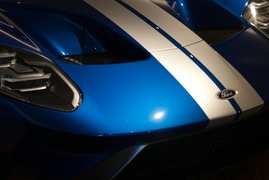
Fast forward to 2017, and Ford returned to its roots with a 3.5-liter twin-turbo EcoBoost V6. This engine was developed in tandem with the Chip Ganassi Racing program, ensuring the road car and the Le Mans racer shared nearly identical internals. The 2017 GT represents the pinnacle of modern performance vehicle engineering, utilizing active aero and a racing-derived suspension to dominate tracks worldwide.
Jaguar XJ220: The Group C Survivor
The Jaguar XJ220 holds a unique place in automotive history. While it was initially promised with a V12, it eventually debuted with a 3.5-liter twin-turbo V6 lifted straight from the Jaguar XJR-11 Group C race car.
Though some buyers were initially disappointed by the cylinder count, the performance was undeniable. The XJ220 produced 542 hp and reached a top speed of 217 mph, briefly holding the title of the world’s fastest production car. This was a true track-proven engine that delivered brutal acceleration, proving that Jaguar’s racing program was decades ahead of its time.
Plymouth Belvedere: The NASCAR “Race Hemi”
The 1964 Plymouth Belvedere might look like a modest family sedan by today’s standards, but in the 1960s, it was a weapon. It was the first road-going vehicle to house the legendary 426 Hemi V8, an engine developed specifically to dominate the high banks of NASCAR.
Known simply as the “Race Hemi,” this motor was so dominant that NASCAR eventually changed the rules regarding engine availability, forcing Chrysler to sell more Hemi-powered cars to the public. Producing 425 hp (understated), the Belvedere was a wolf in sheep’s clothing and solidified the Hemi engine’s legacy as a cornerstone of American motorsport.
Porsche 918 Spyder: LMP2 Hybrid Technology
The Porsche 918 Spyder proved that the future of motorsport DNA is hybrid. Its 4.6-liter V8 was a direct evolution of the engine used in the RS Spyder, a highly successful LMP2 prototype that won its class at Le Mans.
By pairing this high-revving V8 with electric motors, Porsche achieved a combined output of 887 hp and 944 lb-ft of torque. The 918 can sprint from 0-60 mph in a blistering 2.2 seconds. While the electric torque is impressive, the soul of the car is the V8, which screams with the same metallic wail as the endurance racers that came before it. This car set the benchmark for luxury hybrid supercars in the modern era.
Porsche Carrera GT: The Shelved F1 Masterpiece
Widely considered the greatest analog supercar ever built, the Porsche Carrera GT owes its existence to a failed racing program. Its 5.7-liter V10 was originally designed for a Footwork Formula 1 team in the early 90s. When that project was canceled, the engine was resized for a Le Mans prototype, which was also eventually shelved.
Refusing to let the masterpiece go to waste, Porsche engineers placed the V10 into the Carrera GT. With 612 hp, a 6-speed manual transmission, and a ceramic clutch, it is notoriously difficult to drive but immensely rewarding. The Carrera GT’s exhaust note is often cited as the best in automotive history, a direct result of its Formula 1 ancestry.
Experience the Legacy of Speed
These ten vehicles represent more than just transportation; they are historical artifacts of human ambition and engineering excellence. Owning a car with motorsport DNA is an invitation to experience the limits of what is possible on four wheels. As we head into an era of increased electrification, these race-bred, internal-combustion masterpieces are becoming the most coveted assets in the high-end automotive market.
If you are ready to elevate your driving experience and own a piece of racing history, now is the time to explore the world of homologation specials and track-derived legends. Whether you are a seasoned collector or a first-time enthusiast, there is no substitute for the roar of a racing engine.
Ready to find your next race-bred masterpiece? Contact our specialist team today for a curated list of heritage performance vehicles available for acquisition.