
The Heart of a Champion: 10 Street-Legal Monsters with Race-Bred Engines
For those who live and breathe automotive excellence, there is a distinct, visceral thrill that comes from piloting a machine infused with motorsport DNA. We aren’t talking about simple aesthetic packages or “track-inspired” trim levels that consist of nothing more than carbon fiber accents and red stitching. We are talking about the rare breed of high-performance vehicles that house actual power plants originally forged for the podium. These are the engines born in the high-pressure kilns of endurance racing and Formula 1, now tamed—only slightly—for the public tarmac.
As an industry veteran with over a decade spent analyzing powertrain architecture and market trends, I’ve seen the “Win on Sunday, Sell on Monday” philosophy evolve. In 2025, as we stand at the crossroads of hybridization and pure internal combustion, these race-bred engines represent the pinnacle of mechanical soul. They offer a direct, unfiltered connection to the track, delivering high-revving symphonies that modern, muted turbocharged commuters simply cannot replicate.
In this deep dive, we explore 10 production vehicles that successfully bridged the gap between the pit lane and the driveway.
The Engineering Logic: Why Brands Put Race Engines in Road Cars
The synergy between motorsport and road cars is the ultimate R&D laboratory. When an automaker invests millions into a racing program, they aren’t just looking for trophies; they are stress-testing metallurgy, thermal management, and aerodynamics under conditions that no street car would ever endure.
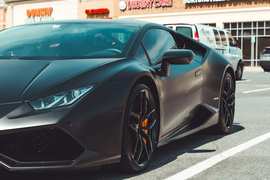
The trickle-down effect is profound. Technologies we now take for granted—such as carbon-ceramic brakes, dual-clutch transmissions, and active suspension—were once exclusive to the grid. However, the most prestigious transfer of technology remains the engine. When a manufacturer places a race-bred engine into a production model, it serves as a “halo” effect, elevating the brand’s perceived engineering prowess and driving up resale values for collectors.
Alfa Romeo Montreal: The Endurance Legend
The Alfa Romeo Montreal is a masterclass in 1970s style, but its true beauty lies beneath the hood. It features a 2.6-liter naturally aspirated V8 derived directly from the legendary Tipo 33 endurance racer.
While the competition version was a 2.0-liter screamer used in the Targa Florio, the road-going Montreal version was bored out for better torque delivery. Despite being “civilized” for the street, it retained its high-performance vehicle characteristics, revving to a glorious 7,000 RPM. Producing 200 hp, it remains one of the most melodic and underrated Italian classics in existence.
The BMW “M” Dynasty (M1, E30 M3, E28 M5)
BMW’s “M” division didn’t earn its reputation through marketing; it earned it through the M88 inline-six engine. Originally developed for the mid-engined BMW M1 and its dedicated ProCar racing series, this 3.5-liter masterpiece eventually found its way into the E24 M6 and the original E28 M5.
Perhaps even more iconic is the E30 M3. Its S14 four-cylinder engine was essentially a “truncated” version of the M88, utilizing the same head design. Built specifically to satisfy DTM racing homologation requirements, the E30 M3 wasn’t just a sports car—it was a literal race car sold in showrooms.
1969 Chevrolet Camaro ZL1: The Aluminum Giant
In the world of American muscle, the 1969 Camaro ZL1 is the “Holy Grail.” At its heart was the 427 cubic-inch (7.0-liter) V8, an all-aluminum beast designed for the brutal Can-Am racing series.
This engine was a marvel of its era, significantly lighter than the standard iron-block big blocks, which drastically improved handling. While officially rated at 430 hp to appease insurance companies, true dyno tests of the era showed it pushing closer to 500 hp. With only 69 units produced, it remains a testament to what happens when motorsport DNA is injected into a pony car.
Ferrari Dino 206 GT: The Formula 2 Heritage
Named after Enzo Ferrari’s son, the Dino 206 GT was a revolutionary departure for the Maranello-based firm. It utilized a 2.0-liter V6 that traced its lineage back to Ferrari’s Formula 2 efforts of the 1960s.
This high-revving V6 allowed for a compact, mid-engine layout that prioritized balance over raw straight-line speed. Producing 180 hp in a chassis weighing just over 2,000 pounds, the Dino offered a level of agility that mirrored the open-wheel racers of the time.
Ferrari F50: A Formula 1 Car in a Tuxedo
If the F40 was a turbocharged riot, the Ferrari F50 was a surgical instrument. To celebrate the brand’s 50th anniversary, Ferrari took the Tipo F130B naturally aspirated V12 directly from Alain Prost’s 1990 Formula 1 car.
They increased the displacement to 4.7 liters for street driveability, but kept the engine as a stressed member of the chassis—just like in F1. When you drive an F50, you aren’t just hearing a race-bred engine; you are feeling the vibrations of the V12 transmitted directly through the seat and into your spine. It is the closest experience to a 1990s Grand Prix car available with a license plate.
Ford GT: The Le Mans Successor
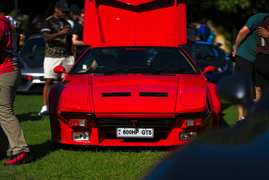
The Ford GT exists because of a grudge and a victory at Le Mans. The 2005 iteration used a 5.4-liter supercharged V8 with architecture shared with Ford’s Daytona Prototype engines.
Moving into 2017, the second-generation GT shifted to a 3.5-liter twin-turbo EcoBoost V6. While some purists missed the V8, the V6 was a direct descendant of the engine that won its class at Le Mans in 2016. It proved that modern performance car parts and smaller displacements could dominate the world stage.
Jaguar XJ220: The Group C Survivor
The Jaguar XJ220’s journey was controversial, switching from a promised V12 to a 3.5-liter twin-turbo V6. However, that V6 was no ordinary unit—it was the TWR (Tom Walkinshaw Racing) engine from the Jaguar XJR-11 Group C racer.
This engine propelled the XJ220 to a top speed of 217 mph, securing its spot as the fastest production car in the world for a time. Its racing pedigree ensured that while it lacked the cylinder count of its rivals, its power delivery was explosive and track-tested.
Plymouth Belvedere: The NASCAR “Elephant”
In 1964, the Plymouth Belvedere became the vessel for the legendary 426 Hemi V8. Known colloquially as the “Elephant Engine” due to its size and power, it was developed specifically to dominate NASCAR’s high-banked ovals.
The “Race Hemi” was so dominant that NASCAR eventually changed the rules, forcing Plymouth to sell a street version to the public for homologation. This 425 hp monster turned the Belvedere into a sleeper that could humble almost anything at a stoplight, cementing the Hemi’s legacy in the high-performance vehicle hall of fame.
Porsche 918 Spyder: The Hybrid Pioneer
The Porsche 918 Spyder proved that the future of speed involves electrification, but its soul remains purely mechanical. Its 4.6-liter naturally aspirated V8 is a direct evolution of the engine found in the RS Spyder LMP2 race car.
By pairing this race-bred engine with two electric motors, Porsche achieved a combined output of 887 hp. The result is a car that can silent-commute on electric power but screams with a flat-plane crank howl once the throttle is pinned. It represents the ultimate 2025-era balance of efficiency and raw motorsport aggression.
Porsche Carrera GT: The Shelved F1 Masterpiece
Many consider the Porsche Carrera GT the greatest supercar ever made. Its 5.7-liter V10 has one of the most fascinating backstories in automotive history. Originally designed as a 3.5-liter V10 for the Footwork Formula 1 team in the early 90s, the project was scrapped. It was later revived for a Le Mans prototype (the LMP2000) which was also cancelled.
Unwilling to let such a masterpiece go to waste, Porsche engineers placed it into the Carrera GT. With a ceramic clutch and a 603 hp output that screams to 8,000 RPM, it is a demanding, pure, and unapologetic tribute to racing engineering.
Experience the Legacy of Speed
Owning a vehicle with a race-bred engine is more than a status symbol; it is an investment in a disappearing era of mechanical purity. As the industry shifts toward autonomy, these machines remind us why we fell in love with driving in the first place. Whether you are looking to acquire a modern classic or simply want to upgrade your current ride with high-performance car parts, understanding the history of these engines is key to appreciating their value.
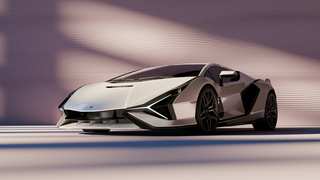
Ready to find your next adrenaline fix? Start your journey by exploring our latest inventory of performance-tuned legends and see what it feels like to have the soul of a champion under your right foot.