
The Enduring Allure of Automotive Design Excellence: A Decade of Industry Insight
For the past ten years, I’ve dedicated myself to unraveling the complex tapestry of automotive design. I’ve spent coun
tless hours poring over the lines, the curves, the very essence of how raw materials are sculpted into vehicles that stir the soul. In an era where electrification, autonomous capabilities, and advanced connectivity are fundamentally redefining the automobile, the unwavering power of exceptional car design remains a constant beacon. This enduring appeal is a profound testament to the fusion of artistry and engineering, transcending mere utility to forge a deep emotional connection with us. My professional experience, coupled with widespread industry consensus, has allowed me to identify vehicles that haven’t just achieved beauty, but have consistently set the benchmark for timeless automotive design. These are the machines that inspire awe, command attention, and have demonstrably shaped the trajectory of design trends across the global automotive landscape.
The notion of what constitutes a “beautiful car” is, inherently, a subjective pursuit. Yet, certain vehicles possess an intrinsic aesthetic quality that resonates universally, transcending temporal boundaries and captivating both seasoned enthusiasts and aspiring designers alike, often for decades after their initial unveiling. These represent a harmonious convergence of groundbreaking innovation, visionary artistic intent, and meticulous craftsmanship. As we navigate the sophisticated landscape of contemporary automotive aesthetics, a deep understanding of the foundational principles established by these iconic creations is paramount. This exploration is not a mere catalog of aesthetically pleasing automobiles; rather, it’s a deep dive into design philosophy, engineering mastery, and the profound emotional impact that elevates an automobile from mere transportation to a truly unforgettable object of desire.
Our journey through the rich annals of automotive artistry commences with a vehicle that, even today, elicits gasps of unadulterated admiration. It’s a machine that definitively proved the mid-engine configuration could achieve not only functional brilliance but also breathtaking visual allure, thereby establishing a new paradigm for sports car proportions and luxury car design.
Ferrari Dino 206/246 GT (1967–1974): A Masterclass in Proportional Harmony
The Dino, affectionately named in honor of Enzo Ferrari’s son, Alfredo “Dino” Ferrari, stands as a monumental achievement in the history of automotive design. What consistently strikes me, and a great many of my esteemed colleagues within the industry, is its extraordinary proportional balance. It’s a triumph of visual harmony, appearing both remarkably compact and dynamically athletic. The low-slung, flowing hood seamlessly integrates into a purposeful, mid-engined silhouette, generating a visual dynamism that was nothing short of revolutionary for its epoch. This is more than just a car; it’s a meticulously crafted sculpture. The rounded, almost organic surfacing imparts a sense of softness that artfully belies its potent performance capabilities, offering a striking contrast to the often sharp-edged designs that would later emerge.
Industry leaders articulate its significance with clarity. Kevin Hunter, President of Toyota’s Calty Design Research, aptly describes it as “Handsomely compressed sculpture with pure, low-hood, mid-engine proportions and purpose.” David Woodhouse, Vice President of Nissan Design America, further emphasizes its profound impact: “Luscious form, exotic and intriguing, the Dino literally invented the iconography of a mid-engine sports car that still holds true today.” Irina Zavatski, Vice President of Chrysler Design, highlights its enduring appeal: “With round, sculptural surfacing, mid-engine proportions, and distinct front-end design, this one always stands out.” The Dino’s influence is undeniably pervasive, shaping the visual lexicon of mid-engine sports cars for successive generations, solidifying its position as a cornerstone of luxury car design and a key reference point for performance car design.
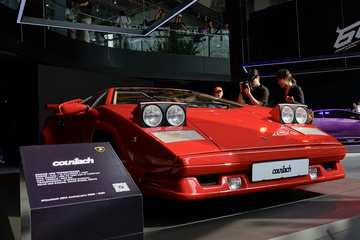
Lamborghini Countach (1974–1990): The Embodiment of Sci-Fi Futurism
Transitioning from the graceful curves of the Dino, we leap into a realm of audacious, almost aggressively futuristic design with the Lamborghini Countach. Penned by the legendary Marcello Gandini, the Countach represents the antithesis of understated elegance. It is an undeniable statement piece, a rolling declaration of intent and unbridled automotive ambition. Its iconic wedgy, angular profile, characterized by sharp creases and dramatic scissor doors, conveyed a sense of having literally landed from another planet. For over 15 years, this extraordinary iconic supercar design dominated the automotive landscape, proving that radical stylistic departures could achieve enduring acclaim and influence the future of car design.
 Industry stalwarts provide insightful commentary. Anthony Lo, Chief Design Officer at Ford Motor Company, captures its revolutionary nature: “Its overall design and proportions were so unexpected and outstanding that it made other supercars of the era look like classic cars.” Domagoj Dukec, Head of Design at BMW, succinctly describes its essence: “The simple and reduced wedge design is pure science fiction.” Henrik Fisker, founder of Fisker Inc., echoes this sentiment, noting, “A true show car that made it to production.” The Countach is not merely about raw performance; it’s about pushing the very boundaries of what a car could visually represent, a crucial aspect of exotic car design and a powerful influence on performance vehicle design.
Alfa Romeo 8C 2900B Lungo Spider (1937–1939, 1941): Pre-War Elegance Personified
Journeying further back in time, we encounter the Alfa Romeo 8C 2900B Lungo Spider, a true masterpiece of pre-war automotive artistry. Engineered with formidable racing prowess in mind, particularly for demanding endurance events like the Mille Miglia, this automobile exudes a level of sophistication that is exceptionally rare. Its long, flowing lines, the distinctive grille, and its purposeful, grounded stance speak eloquently of an era where automotive design was inextricably intertwined with unparalleled engineering excellence. The bodies, often masterfully crafted by Carrozzeria Touring, stand as a profound testament to the lost art of coachbuilding, making it a benchmark for vintage car design.
Ralph Gilles, Head of Design at Stellantis, articulates its commanding presence with authority: “This Alfa makes all others cringe when it rolls onto the lawn of any concours.” This sentiment powerfully underscores the 8C 2900B’s innate ability to command universal attention and admiration, even within a gathering of the world’s most exquisite automobiles. It represents the absolute pinnacle of classic car beauty, a seamless blend of competitive racing pedigree and opulent styling that remains utterly captivating and a cornerstone of European car design.
Ferrari 250 GTO (1962–1964): The Apex of Front-Engine Grand Touring
The Ferrari 250 GTO transcends the definition of a mere automobile; it is an automotive legend. Its very genesis, born from the stringent requirements for racing homologation, dictated its design. The resulting aerodynamic efficiency, the perfectly balanced proportions, and the sheer, unadulterated aggression of its stance all contribute to its enduring and profound appeal. Whether in its Series I or Series II configuration, the 250 GTO remains an irrefutable benchmark for front-engine sports car design. Its extreme rarity and illustrious racing pedigree only serve to amplify its almost mythical status.
Industry luminaries offer glowing endorsements. Jeff Hammoud, Head of Design at Rivian, unequivocally calls it “The definition of a sexy, front-engine sports car.” Robin Page, Head of Global Design and UX at Volvo, praises its “Pioneering aerodynamics shaped this gorgeous car.” Ralph Gilles reiterates its unparalleled status: “One of the most beautiful cars of all time.” Peter Brock, a designer with a distinguished career at GM and Shelby America, offers a particularly profound insight: “Still the elegant high point in front-engine GT design.” The 250 GTO stands as a prime example of how performance car design and aesthetic beauty can converge to create something truly transcendent. Indeed, any exploration of automotive design history would be incomplete without acknowledging the 250 GTO.
Bugatti Type 57 S/SC Atlantic Coupé (1936–1938): Art Deco Masterpiece on Wheels
The Bugatti Type 57 S/SC Atlantic Coupé is an undisputed automotive icon, a breathtaking fusion of Art Deco aesthetics and unparalleled mechanical brilliance. Its distinctive “Atlantic” bodywork, immediately recognizable by its low-slung profile, flowing fenders, and the prominent dorsal fin, is a design triumph. This was a vehicle conceived for a discerning elite, a definitive statement of wealth, impeccable taste, and profound engineering sophistication. The designation “S” for Surbaissé (lowered) and “C” for Compresseur (supercharger) denote performance enhancements that perfectly complemented its already stunning visual appearance, making it a benchmark in luxury car aesthetics.
Klaus Zyciora, Head of Design at Volkswagen Group, succinctly describes it as “Super elegant, yet ingenious.” Ian Cartabiano, Vice President of Advanced Design at Toyota, notes its “Dramatic combination of curves and undulating proportions.” The Atlantic exemplifies how luxury car aesthetics can be profoundly intertwined with avant-garde design principles, distinguishing it as a standout in the realm of vintage sports car design and a significant contribution to European car design.
Mercedes-Benz 300SL (1954–1957): Gullwing Grace and Engineering Prowess
The Mercedes-Benz 300SL, particularly in its iconic gullwing coupe form, is a vehicle that fundamentally redefined both automotive performance and style. Drawing direct inspiration from its racing counterpart, the W194, the 300SL achieved the status of the fastest production car of its era. Its revolutionary gullwing doors, while a striking design feature, were born out of necessity due to the constraints of its race-bred chassis. However, it is the vehicle’s overall proportion, its sleek silhouette, and its understated yet palpable aggression that truly cement its place in the pantheon of beautiful automobiles and influence premium car styling.
Ian Cartabiano, Vice President of Advanced Design at Toyota, perfectly encapsulates its broad appeal: “Almost the perfect balance of elements, including the turret-top cabin. Sleek without being curvy, powerful without being brutal.” SangYup Lee, Head of Hyundai’s Global Design Center, hails it as the “Most elegant German sports car.” Robin Page, Head of Global Design and UX at Volvo, acknowledges the doors’ iconic status: “Beautifully engineered gullwing doors make this a legend.” The 300SL remains a critical touchstone for automotive innovation and design excellence, continuing to inspire discussions on premium car styling.
Porsche 911 (1964–Present): The Unfolding Evolution of an Icon
Industry stalwarts provide insightful commentary. Anthony Lo, Chief Design Officer at Ford Motor Company, captures its revolutionary nature: “Its overall design and proportions were so unexpected and outstanding that it made other supercars of the era look like classic cars.” Domagoj Dukec, Head of Design at BMW, succinctly describes its essence: “The simple and reduced wedge design is pure science fiction.” Henrik Fisker, founder of Fisker Inc., echoes this sentiment, noting, “A true show car that made it to production.” The Countach is not merely about raw performance; it’s about pushing the very boundaries of what a car could visually represent, a crucial aspect of exotic car design and a powerful influence on performance vehicle design.
Alfa Romeo 8C 2900B Lungo Spider (1937–1939, 1941): Pre-War Elegance Personified
Journeying further back in time, we encounter the Alfa Romeo 8C 2900B Lungo Spider, a true masterpiece of pre-war automotive artistry. Engineered with formidable racing prowess in mind, particularly for demanding endurance events like the Mille Miglia, this automobile exudes a level of sophistication that is exceptionally rare. Its long, flowing lines, the distinctive grille, and its purposeful, grounded stance speak eloquently of an era where automotive design was inextricably intertwined with unparalleled engineering excellence. The bodies, often masterfully crafted by Carrozzeria Touring, stand as a profound testament to the lost art of coachbuilding, making it a benchmark for vintage car design.
Ralph Gilles, Head of Design at Stellantis, articulates its commanding presence with authority: “This Alfa makes all others cringe when it rolls onto the lawn of any concours.” This sentiment powerfully underscores the 8C 2900B’s innate ability to command universal attention and admiration, even within a gathering of the world’s most exquisite automobiles. It represents the absolute pinnacle of classic car beauty, a seamless blend of competitive racing pedigree and opulent styling that remains utterly captivating and a cornerstone of European car design.
Ferrari 250 GTO (1962–1964): The Apex of Front-Engine Grand Touring
The Ferrari 250 GTO transcends the definition of a mere automobile; it is an automotive legend. Its very genesis, born from the stringent requirements for racing homologation, dictated its design. The resulting aerodynamic efficiency, the perfectly balanced proportions, and the sheer, unadulterated aggression of its stance all contribute to its enduring and profound appeal. Whether in its Series I or Series II configuration, the 250 GTO remains an irrefutable benchmark for front-engine sports car design. Its extreme rarity and illustrious racing pedigree only serve to amplify its almost mythical status.
Industry luminaries offer glowing endorsements. Jeff Hammoud, Head of Design at Rivian, unequivocally calls it “The definition of a sexy, front-engine sports car.” Robin Page, Head of Global Design and UX at Volvo, praises its “Pioneering aerodynamics shaped this gorgeous car.” Ralph Gilles reiterates its unparalleled status: “One of the most beautiful cars of all time.” Peter Brock, a designer with a distinguished career at GM and Shelby America, offers a particularly profound insight: “Still the elegant high point in front-engine GT design.” The 250 GTO stands as a prime example of how performance car design and aesthetic beauty can converge to create something truly transcendent. Indeed, any exploration of automotive design history would be incomplete without acknowledging the 250 GTO.
Bugatti Type 57 S/SC Atlantic Coupé (1936–1938): Art Deco Masterpiece on Wheels
The Bugatti Type 57 S/SC Atlantic Coupé is an undisputed automotive icon, a breathtaking fusion of Art Deco aesthetics and unparalleled mechanical brilliance. Its distinctive “Atlantic” bodywork, immediately recognizable by its low-slung profile, flowing fenders, and the prominent dorsal fin, is a design triumph. This was a vehicle conceived for a discerning elite, a definitive statement of wealth, impeccable taste, and profound engineering sophistication. The designation “S” for Surbaissé (lowered) and “C” for Compresseur (supercharger) denote performance enhancements that perfectly complemented its already stunning visual appearance, making it a benchmark in luxury car aesthetics.
Klaus Zyciora, Head of Design at Volkswagen Group, succinctly describes it as “Super elegant, yet ingenious.” Ian Cartabiano, Vice President of Advanced Design at Toyota, notes its “Dramatic combination of curves and undulating proportions.” The Atlantic exemplifies how luxury car aesthetics can be profoundly intertwined with avant-garde design principles, distinguishing it as a standout in the realm of vintage sports car design and a significant contribution to European car design.
Mercedes-Benz 300SL (1954–1957): Gullwing Grace and Engineering Prowess
The Mercedes-Benz 300SL, particularly in its iconic gullwing coupe form, is a vehicle that fundamentally redefined both automotive performance and style. Drawing direct inspiration from its racing counterpart, the W194, the 300SL achieved the status of the fastest production car of its era. Its revolutionary gullwing doors, while a striking design feature, were born out of necessity due to the constraints of its race-bred chassis. However, it is the vehicle’s overall proportion, its sleek silhouette, and its understated yet palpable aggression that truly cement its place in the pantheon of beautiful automobiles and influence premium car styling.
Ian Cartabiano, Vice President of Advanced Design at Toyota, perfectly encapsulates its broad appeal: “Almost the perfect balance of elements, including the turret-top cabin. Sleek without being curvy, powerful without being brutal.” SangYup Lee, Head of Hyundai’s Global Design Center, hails it as the “Most elegant German sports car.” Robin Page, Head of Global Design and UX at Volvo, acknowledges the doors’ iconic status: “Beautifully engineered gullwing doors make this a legend.” The 300SL remains a critical touchstone for automotive innovation and design excellence, continuing to inspire discussions on premium car styling.
Porsche 911 (1964–Present): The Unfolding Evolution of an Icon
 The Porsche 911 presents a unique and fascinating case study in the principles of automotive design longevity. Debuting in 1964, it was not initially celebrated for its aesthetic beauty in the same immediate way as some of its contemporaries. However, over more than six decades, through a process of constant, intelligent, and evolutionary refinement, the 911 has transformed into arguably one of the most recognizable and aesthetically coherent designs in the entire history of automotive manufacturing. The perennial challenge for Porsche designers has consistently been to preserve the brand’s core DNA while simultaneously injecting fresh appeal with each successive generation. Their success in this endeavor has been nothing short of spectacular, making it a benchmark for brand design consistency and sports car silhouette.
Henrik Fisker, founder of Fisker Inc., boldly declares it “Perfect sculpture and surfacing. The ultimate example of design perfection.” Karim Habib, Head of Design at Kia, astutely notes, “Redesigning an icon is no easy feat.” Ralph Gilles summarizes its ongoing triumph: “Its designers have continually honed this theme and made it into one of the most iconic designs of all time.” The 911 is a powerful testament to the efficacy of iterative design and the enduring allure of a consistent, impeccably executed vision, serving as a masterclass in brand design consistency and the enduring appeal of a sports car silhouette.
Chevrolet Corvette Sting Ray Split-Window Coupe (1963): American Audacity Redefined
The 1963 Chevrolet Corvette Sting Ray split-window coupe represented a seismic shift in American automotive design. Emerging from the secretive “Studio X,” a clandestine design hub, it captivated the world with its otherworldly, aerodynamically sophisticated form. Drawing inspiration from European racing machines and cutting-edge aircraft design, it featured innovative hidden headlamps, a sharp, crisp beltline, and the unforgettable split rear window. This vehicle was a bold and unequivocal declaration of intent, powerfully showcasing American ingenuity and a burgeoning appreciation for sleek, performance-oriented aesthetics, making it a prime example of retro automotive styling.
Jeff Hammoud, Head of Design at Rivian, praises it as “Most beautiful Corvette designed. Great combination of sculpture and sharp lines.” Ralph Gilles eloquently describes its dynamic presence: “It carries an incredible sense of motion with its Mako Shark–inspired body, hidden headlamps, and iconic split window.” The ’63 Corvette signifies a pivotal moment in American car design, conclusively proving that the United States could produce vehicles that not only rivaled but could also set new standards for style and innovation on a global scale. It is a definitive example of retro automotive styling.
Lamborghini Miura P400/P400S (1967–1971): The Zenith of Mid-Engine Design
The Lamborghini Miura is almost universally acclaimed as one of the most beautiful cars ever created, and for profoundly compelling reasons. It was the vehicle that definitively established the mid-engine layout as the absolute pinnacle of exotic car design. Its proportions are simply breathtaking: low, wide, and possessing an almost impossibly sensuous form. The design, masterfully attributed to Marcello Gandini of Bertone, is a harmonious symphony of flowing curves and subtle, elegant creases, with the iconic “eyelashes” framing the headlights adding a distinctive and memorable character. The Miura was not merely fast; it was, in essence, automotive art brought to life, setting the benchmark for supercar aesthetics.
Peter Brock, a designer with extensive experience at General Motors and Shelby America, declared it “The P400 Miura stunned the world as the most innovative and spectacular supercar ever seen.” Ralph Gilles remains captivated by its lines: “I am still in awe of its hood and shoulder line that blends into the upper door and frames the scoops adjacent to the side windows.” Anthony Lo highlights its perfect integration: “Gorgeous proportion, as if the body was shrink-wrapped around the mechanicals.” Kevin Hunter describes its elegance: “Taut and restrained athletic elegance.” Irina Zavatski adds, “It always stops me in my tracks.” The Miura serves as the ultimate benchmark for supercar aesthetics and remains a timeless source of inspiration for automotive art.
Jaguar E-Type Coupe (1961–1967): The Epitome of Automotive Beauty
It is a rare and exceptional feat for any automobile to be universally lauded as the most beautiful car ever created, yet the Jaguar E-Type Coupe has unequivocally achieved this distinction. Enzo Ferrari himself is famously rumored to have bestowed this superlative title upon it, and our panel of leading automotive designers wholeheartedly concurs. From its famously long, purposeful bonnet that gracefully conceals a potent inline-six engine, to its perfectly proportioned cockpit and elegantly tapered rear, the E-Type is an absolute study in automotive grace and elegance. It seamlessly blends exhilarating performance with an almost erotic aesthetic appeal, solidifying its status as an enduring icon and the ultimate expression of automotive elegance, making it the gold standard for classic sports car design.
Ian Cartabiano, Vice President of Advanced Design at Toyota, perfectly captures its timeless allure: “Long, low, sensual. Still looks amazing.” Michelle Christensen, Vice President of Global Design at Honda, describes its enduring impact: “Romantic proportions, elegant, timeless, forever the most beautiful.” David Woodhouse, Vice President of Nissan Design America, offers a superlative summary: “Delectable. Delicious. Sublime! Universally appealing sculpture on wheels. Drop-dead gorgeous!” The Jaguar E-Type is the ultimate expression of automotive elegance and a powerful, enduring reminder that the most effective vehicle design often resides in the perfect interplay of simplicity, proportion, and a touch of raw, untamed beauty. It remains the undisputed gold standard for classic sports car design and continues to profoundly influence the future of car design.
These vehicles, each representing a unique epoch and design philosophy, collectively embody the pinnacle of automotive design achievement. They are far more than mere instruments of transportation; they are rolling sculptures, tangible testaments to human creativity, unparalleled engineering brilliance, and the indelible, enduring power of beauty.
As we cast our gaze towards the future of automotive design, increasingly shaped by the imperatives of sustainability and technological innovation, a deep appreciation for these iconic designs provides invaluable context and perspective. The fundamental principles of proportion, form, and the creation of emotional resonance – the very elements that rendered these cars so universally beautiful – remain as critically relevant today as they were decades ago.
The Porsche 911 presents a unique and fascinating case study in the principles of automotive design longevity. Debuting in 1964, it was not initially celebrated for its aesthetic beauty in the same immediate way as some of its contemporaries. However, over more than six decades, through a process of constant, intelligent, and evolutionary refinement, the 911 has transformed into arguably one of the most recognizable and aesthetically coherent designs in the entire history of automotive manufacturing. The perennial challenge for Porsche designers has consistently been to preserve the brand’s core DNA while simultaneously injecting fresh appeal with each successive generation. Their success in this endeavor has been nothing short of spectacular, making it a benchmark for brand design consistency and sports car silhouette.
Henrik Fisker, founder of Fisker Inc., boldly declares it “Perfect sculpture and surfacing. The ultimate example of design perfection.” Karim Habib, Head of Design at Kia, astutely notes, “Redesigning an icon is no easy feat.” Ralph Gilles summarizes its ongoing triumph: “Its designers have continually honed this theme and made it into one of the most iconic designs of all time.” The 911 is a powerful testament to the efficacy of iterative design and the enduring allure of a consistent, impeccably executed vision, serving as a masterclass in brand design consistency and the enduring appeal of a sports car silhouette.
Chevrolet Corvette Sting Ray Split-Window Coupe (1963): American Audacity Redefined
The 1963 Chevrolet Corvette Sting Ray split-window coupe represented a seismic shift in American automotive design. Emerging from the secretive “Studio X,” a clandestine design hub, it captivated the world with its otherworldly, aerodynamically sophisticated form. Drawing inspiration from European racing machines and cutting-edge aircraft design, it featured innovative hidden headlamps, a sharp, crisp beltline, and the unforgettable split rear window. This vehicle was a bold and unequivocal declaration of intent, powerfully showcasing American ingenuity and a burgeoning appreciation for sleek, performance-oriented aesthetics, making it a prime example of retro automotive styling.
Jeff Hammoud, Head of Design at Rivian, praises it as “Most beautiful Corvette designed. Great combination of sculpture and sharp lines.” Ralph Gilles eloquently describes its dynamic presence: “It carries an incredible sense of motion with its Mako Shark–inspired body, hidden headlamps, and iconic split window.” The ’63 Corvette signifies a pivotal moment in American car design, conclusively proving that the United States could produce vehicles that not only rivaled but could also set new standards for style and innovation on a global scale. It is a definitive example of retro automotive styling.
Lamborghini Miura P400/P400S (1967–1971): The Zenith of Mid-Engine Design
The Lamborghini Miura is almost universally acclaimed as one of the most beautiful cars ever created, and for profoundly compelling reasons. It was the vehicle that definitively established the mid-engine layout as the absolute pinnacle of exotic car design. Its proportions are simply breathtaking: low, wide, and possessing an almost impossibly sensuous form. The design, masterfully attributed to Marcello Gandini of Bertone, is a harmonious symphony of flowing curves and subtle, elegant creases, with the iconic “eyelashes” framing the headlights adding a distinctive and memorable character. The Miura was not merely fast; it was, in essence, automotive art brought to life, setting the benchmark for supercar aesthetics.
Peter Brock, a designer with extensive experience at General Motors and Shelby America, declared it “The P400 Miura stunned the world as the most innovative and spectacular supercar ever seen.” Ralph Gilles remains captivated by its lines: “I am still in awe of its hood and shoulder line that blends into the upper door and frames the scoops adjacent to the side windows.” Anthony Lo highlights its perfect integration: “Gorgeous proportion, as if the body was shrink-wrapped around the mechanicals.” Kevin Hunter describes its elegance: “Taut and restrained athletic elegance.” Irina Zavatski adds, “It always stops me in my tracks.” The Miura serves as the ultimate benchmark for supercar aesthetics and remains a timeless source of inspiration for automotive art.
Jaguar E-Type Coupe (1961–1967): The Epitome of Automotive Beauty
It is a rare and exceptional feat for any automobile to be universally lauded as the most beautiful car ever created, yet the Jaguar E-Type Coupe has unequivocally achieved this distinction. Enzo Ferrari himself is famously rumored to have bestowed this superlative title upon it, and our panel of leading automotive designers wholeheartedly concurs. From its famously long, purposeful bonnet that gracefully conceals a potent inline-six engine, to its perfectly proportioned cockpit and elegantly tapered rear, the E-Type is an absolute study in automotive grace and elegance. It seamlessly blends exhilarating performance with an almost erotic aesthetic appeal, solidifying its status as an enduring icon and the ultimate expression of automotive elegance, making it the gold standard for classic sports car design.
Ian Cartabiano, Vice President of Advanced Design at Toyota, perfectly captures its timeless allure: “Long, low, sensual. Still looks amazing.” Michelle Christensen, Vice President of Global Design at Honda, describes its enduring impact: “Romantic proportions, elegant, timeless, forever the most beautiful.” David Woodhouse, Vice President of Nissan Design America, offers a superlative summary: “Delectable. Delicious. Sublime! Universally appealing sculpture on wheels. Drop-dead gorgeous!” The Jaguar E-Type is the ultimate expression of automotive elegance and a powerful, enduring reminder that the most effective vehicle design often resides in the perfect interplay of simplicity, proportion, and a touch of raw, untamed beauty. It remains the undisputed gold standard for classic sports car design and continues to profoundly influence the future of car design.
These vehicles, each representing a unique epoch and design philosophy, collectively embody the pinnacle of automotive design achievement. They are far more than mere instruments of transportation; they are rolling sculptures, tangible testaments to human creativity, unparalleled engineering brilliance, and the indelible, enduring power of beauty.
As we cast our gaze towards the future of automotive design, increasingly shaped by the imperatives of sustainability and technological innovation, a deep appreciation for these iconic designs provides invaluable context and perspective. The fundamental principles of proportion, form, and the creation of emotional resonance – the very elements that rendered these cars so universally beautiful – remain as critically relevant today as they were decades ago.
 If you find yourself captivated by the artistry and engineering brilliance that defines these automotive masterpieces, or if you are in pursuit of a vehicle that embodies timeless design principles alongside exceptional performance, we warmly invite you to explore our carefully curated selection of current models. These contemporary vehicles proudly carry forward this rich legacy, demonstrating how modern innovation seamlessly integrates with iconic style. We encourage you to experience firsthand the thrill and sophistication of driving a vehicle that is, in every sense, a piece of automotive history.