
The Pursuit of Velocity: Unveiling the Apex of Automotive Speed in 2026
For a decade, I’ve been immersed in the heart of the automotive world, witnessing firsthand the relentless evolution of engineer
ing and the unyielding human desire to push boundaries. This journey has taken me from the grease-stained pits of grassroots racing to the meticulously polished showrooms of global luxury brands. In that time, one constant has been the allure of pure, unadulterated speed – the very essence of what it means to craft the world’s fastest road cars. While the everyday driver may find the nuances of a car’s absolute top speed largely irrelevant in their daily commute, for enthusiasts, collectors, and manufacturers alike, it represents a pinnacle of achievement, a testament to innovation, and, let’s be honest, the ultimate bragging rights.
The quest for speed is not merely a statistical game; it’s a complex ballet of aerodynamic mastery, monumental powertrain development, and meticulous engineering. It’s about taking a concept from the drawing board, proving its mettle on demanding test tracks, and then homologating it for public roads – a feat that requires navigating a labyrinth of safety regulations and emissions standards. This dual challenge is what elevates a vehicle from a mere mode of transportation to a coveted artifact of performance. Each iteration of the fastest cars in the world is a narrative of human ingenuity, a story whispered through the whine of turbos, the thunder of V16s, and the silent surge of electric powertrains.
The history of automotive speed is punctuated by legendary battles. In the 1990s, icons like the Ferrari F40, Porsche 959, Jaguar XJ220, and the indomitable McLaren F1 captured the imagination, pushing the envelope of what was thought possible for a production car. These machines, with their naturally aspirated engines and avant-garde designs, were the harbingers of a new era, proving that road-legal vehicles could achieve speeds previously confined to the racetrack. Fast forward to today, and the landscape has transformed dramatically. We’re no longer just inching towards the 200 mph mark; we’re contemplating the monumental feat of consistently exceeding 300 mph, a barrier that represents a quantum leap in engineering complexity and cost.
This evolution is intrinsically linked to technological advancement. The rapid maturation of electric vehicle (EV) technology has been a seismic shift. What was once the domain of established titans with decades of internal combustion engine expertise is now open territory for nimble startups. Battery technology, power density, and thermal management systems have advanced at an astonishing pace, allowing new players to challenge established marques with pure electric hypercars that deliver mind-bending acceleration and staggering top speeds. This democratization of extreme performance means the fastest accelerating cars are no longer solely the purview of a select few; the competitive field is widening, bringing with it exciting new contenders and pushing the boundaries of automotive possibility.
As of 2026, the definitive list of the world’s fastest road cars is a dynamic entity, perpetually being rewritten by ambitious manufacturers and groundbreaking innovations. This compilation aims to provide an authoritative overview, focusing on production vehicles and avoiding heavily modified or one-off creations. We delve into the specifications, the engineering prowess, and the sheer audacity that propels these machines to the stratospheric speeds they achieve, offering a glimpse into the cutting edge of automotive performance.
The Elite Vanguard: A Countdown of the Fastest Road Cars in 2026
 This curated list represents the pinnacle of automotive speed, a testament to engineering excellence and a bold statement of intent from manufacturers worldwide. While sheer top speed is the primary metric, we also consider the overall package – the technology, the exclusivity, and the impact these vehicles have on the automotive psyche.
McLaren F1 (1998) – Top Speed: 240.1 mph
A true legend. Even decades after its inception, the McLaren F1 remains an enthusiast’s benchmark. Its record-breaking run in 1998, powered by a naturally-aspirated V8 and a manual gearbox, stands as a monument to analog automotive greatness. Its spiritual successor, the Gordon Murray Automotive T.50, is rumored to approach or even surpass its figures, though official data remains elusive, keeping the F1’s iconic status firmly intact. The F1 isn’t just about speed; it’s about a purity of driving experience that few modern machines can replicate.
W Motors Fenyr Supersport – Top Speed: 245 mph
Emerging from the Middle East, W Motors has carved a niche for itself with extravagant and high-performance machines. The Fenyr Supersport, a follow-up to the already extravagant Lykan HyperSport, boasts a Ruf-tuned twin-turbo flat-six engine. While its claimed top speed of 245 mph places it firmly in elite company, the Fenyr’s true appeal lies in its bespoke luxury, incorporating precious materials that underscore its ultra-exclusive nature. It’s a statement piece as much as a speed machine.
Saleen S7 Twin Turbo – Top Speed: 248 mph
The Saleen S7 Twin Turbo, unleashed in 2005, was an unapologetically American brute. Its stated top speed of 248 mph edged out the McLaren F1, a bold claim for a car built on American ingenuity rather than the established European infrastructure of its rivals. Powered by a potent V8 engine flanked by two substantial turbos, the S7 was designed for raw power and aerodynamic efficiency. While its top speed was never definitively proven in a public setting, its presence on this list is a testament to its ambitious engineering.
Koenigsegg Gemera & CCXR – Top Speed: 248 mph
Swedish hypercar manufacturer Koenigsegg consistently features on any list of the fastest cars, and for good reason. Here, we acknowledge two distinct models that share an impressive 248 mph (400 km/h) top speed. The Gemera is a revolutionary four-seat hybrid, featuring an array of electric motors and a combustion engine, showcasing a forward-thinking approach to performance. The CCXR, a significantly older model, achieved the same speed through a supercharged V8, highlighting Koenigsegg’s enduring engineering philosophy.
Aspark Owl – Top Speed: 249 mph
The automotive landscape is increasingly becoming a proving ground for smaller, specialized manufacturers. The Japanese Aspark Owl is a prime example, a hand-built, all-electric hypercar with stratospheric on-paper performance. Its claimed 0-60 mph time of 1.72 seconds would make it the fastest accelerating production car. With a quoted top speed of 249 mph and an output of 1,985 bhp, the Owl’s relatively small 64 kWh battery pack is a marvel of energy density, enabling both extreme performance and a respectable range. This car is a testament to the potential of electric propulsion.
Ultima RS – Top Speed: 250 mph
The Ultima RS stands out as an anomaly on this list, not just for its significantly lower price point but for its classification as a kit car. The prospect of achieving 250 mph in a vehicle assembled at home might seem far-fetched, but the RS proves it’s attainable for those with the requisite skills and capital. Its performance is a triumph of old-school power-to-weight ratios, utilizing a lightweight chassis and a potent, tuned Corvette engine producing 1,200 bhp. It’s a purist’s dream, prioritizing mechanical engagement over electronic wizardry.
McLaren Speedtail – Top Speed: 250 mph
Following in the legendary footsteps of the F1, the McLaren Speedtail is a hyper-grand tourer that embodies aerodynamic elegance and blistering speed. McLaren’s assertion that the Speedtail surpassed 250 mph on over 30 occasions during testing at the Kennedy Space Center in Florida underscores its exceptional capabilities. Limited to just 106 units, mirroring the F1’s production run, it shares the F1’s unique three-seat configuration. Unlike its predecessor, the Speedtail adopts a more modern, seamless approach to its drivetrain, enhancing the driving experience for its fortunate owners.
Czinger 21C V Max – Top Speed: 253 mph+
The Czinger 21C, a name that might evoke a sense of futuristic nomenclature, is undeniably one of the fastest machines on the planet. This hypercar blends an immensely powerful hybrid powertrain, delivering a combined 1,233 bhp, with aggressively aerodynamic bodywork. The V Max variant, specifically designed to maximize top speed, dispenses with certain drag-inducing aerodynamic elements found on the standard model, pushing its velocity beyond the 250 mph mark. Its 0-62 mph sprint in just 1.9 seconds, aided by its all-wheel-drive system, is equally impressive, showcasing its multifaceted performance prowess.
Koenigsegg Regera – Top Speed: 255 mph
Koenigsegg’s relentless pursuit of speed is personified by the Regera. While not their absolute fastest offering, it achieves a remarkable 255 mph thanks to its innovative hybrid powertrain, which churns out close to 1,500 bhp. The Regera’s engineering brilliance is highlighted by its unique single-speed transmission, a direct consequence of its plug-in hybrid setup, eliminating the need for a conventional gearbox. This Swedish marvel combines a potent twin-turbo V8 with advanced electric propulsion, all wrapped in a sleek coupe body with a removable targa top, offering a versatile and electrifying performance experience. It also holds a significant 0–249–0mph acceleration and braking record.
SSC Ultimate Aero – Top Speed: 256.18 mph
The SSC Ultimate Aero was a car that genuinely challenged the established order. Powered by a 1,183 bhp twin-turbo V8, it famously dethroned the Bugatti Veyron as the world’s fastest production car with a verified top speed of 256.18 mph. This remarkable feat was achieved on a temporarily closed public highway in Washington, USA, cementing the Ultimate Aero’s place in automotive history. For an even more visceral experience, SSC opted to forgo electronic driver aids like traction control, delivering an unadulterated, raw driving sensation.
Rimac Nevera/Nevera R – Top Speed: 258 mph / 268 mph
This curated list represents the pinnacle of automotive speed, a testament to engineering excellence and a bold statement of intent from manufacturers worldwide. While sheer top speed is the primary metric, we also consider the overall package – the technology, the exclusivity, and the impact these vehicles have on the automotive psyche.
McLaren F1 (1998) – Top Speed: 240.1 mph
A true legend. Even decades after its inception, the McLaren F1 remains an enthusiast’s benchmark. Its record-breaking run in 1998, powered by a naturally-aspirated V8 and a manual gearbox, stands as a monument to analog automotive greatness. Its spiritual successor, the Gordon Murray Automotive T.50, is rumored to approach or even surpass its figures, though official data remains elusive, keeping the F1’s iconic status firmly intact. The F1 isn’t just about speed; it’s about a purity of driving experience that few modern machines can replicate.
W Motors Fenyr Supersport – Top Speed: 245 mph
Emerging from the Middle East, W Motors has carved a niche for itself with extravagant and high-performance machines. The Fenyr Supersport, a follow-up to the already extravagant Lykan HyperSport, boasts a Ruf-tuned twin-turbo flat-six engine. While its claimed top speed of 245 mph places it firmly in elite company, the Fenyr’s true appeal lies in its bespoke luxury, incorporating precious materials that underscore its ultra-exclusive nature. It’s a statement piece as much as a speed machine.
Saleen S7 Twin Turbo – Top Speed: 248 mph
The Saleen S7 Twin Turbo, unleashed in 2005, was an unapologetically American brute. Its stated top speed of 248 mph edged out the McLaren F1, a bold claim for a car built on American ingenuity rather than the established European infrastructure of its rivals. Powered by a potent V8 engine flanked by two substantial turbos, the S7 was designed for raw power and aerodynamic efficiency. While its top speed was never definitively proven in a public setting, its presence on this list is a testament to its ambitious engineering.
Koenigsegg Gemera & CCXR – Top Speed: 248 mph
Swedish hypercar manufacturer Koenigsegg consistently features on any list of the fastest cars, and for good reason. Here, we acknowledge two distinct models that share an impressive 248 mph (400 km/h) top speed. The Gemera is a revolutionary four-seat hybrid, featuring an array of electric motors and a combustion engine, showcasing a forward-thinking approach to performance. The CCXR, a significantly older model, achieved the same speed through a supercharged V8, highlighting Koenigsegg’s enduring engineering philosophy.
Aspark Owl – Top Speed: 249 mph
The automotive landscape is increasingly becoming a proving ground for smaller, specialized manufacturers. The Japanese Aspark Owl is a prime example, a hand-built, all-electric hypercar with stratospheric on-paper performance. Its claimed 0-60 mph time of 1.72 seconds would make it the fastest accelerating production car. With a quoted top speed of 249 mph and an output of 1,985 bhp, the Owl’s relatively small 64 kWh battery pack is a marvel of energy density, enabling both extreme performance and a respectable range. This car is a testament to the potential of electric propulsion.
Ultima RS – Top Speed: 250 mph
The Ultima RS stands out as an anomaly on this list, not just for its significantly lower price point but for its classification as a kit car. The prospect of achieving 250 mph in a vehicle assembled at home might seem far-fetched, but the RS proves it’s attainable for those with the requisite skills and capital. Its performance is a triumph of old-school power-to-weight ratios, utilizing a lightweight chassis and a potent, tuned Corvette engine producing 1,200 bhp. It’s a purist’s dream, prioritizing mechanical engagement over electronic wizardry.
McLaren Speedtail – Top Speed: 250 mph
Following in the legendary footsteps of the F1, the McLaren Speedtail is a hyper-grand tourer that embodies aerodynamic elegance and blistering speed. McLaren’s assertion that the Speedtail surpassed 250 mph on over 30 occasions during testing at the Kennedy Space Center in Florida underscores its exceptional capabilities. Limited to just 106 units, mirroring the F1’s production run, it shares the F1’s unique three-seat configuration. Unlike its predecessor, the Speedtail adopts a more modern, seamless approach to its drivetrain, enhancing the driving experience for its fortunate owners.
Czinger 21C V Max – Top Speed: 253 mph+
The Czinger 21C, a name that might evoke a sense of futuristic nomenclature, is undeniably one of the fastest machines on the planet. This hypercar blends an immensely powerful hybrid powertrain, delivering a combined 1,233 bhp, with aggressively aerodynamic bodywork. The V Max variant, specifically designed to maximize top speed, dispenses with certain drag-inducing aerodynamic elements found on the standard model, pushing its velocity beyond the 250 mph mark. Its 0-62 mph sprint in just 1.9 seconds, aided by its all-wheel-drive system, is equally impressive, showcasing its multifaceted performance prowess.
Koenigsegg Regera – Top Speed: 255 mph
Koenigsegg’s relentless pursuit of speed is personified by the Regera. While not their absolute fastest offering, it achieves a remarkable 255 mph thanks to its innovative hybrid powertrain, which churns out close to 1,500 bhp. The Regera’s engineering brilliance is highlighted by its unique single-speed transmission, a direct consequence of its plug-in hybrid setup, eliminating the need for a conventional gearbox. This Swedish marvel combines a potent twin-turbo V8 with advanced electric propulsion, all wrapped in a sleek coupe body with a removable targa top, offering a versatile and electrifying performance experience. It also holds a significant 0–249–0mph acceleration and braking record.
SSC Ultimate Aero – Top Speed: 256.18 mph
The SSC Ultimate Aero was a car that genuinely challenged the established order. Powered by a 1,183 bhp twin-turbo V8, it famously dethroned the Bugatti Veyron as the world’s fastest production car with a verified top speed of 256.18 mph. This remarkable feat was achieved on a temporarily closed public highway in Washington, USA, cementing the Ultimate Aero’s place in automotive history. For an even more visceral experience, SSC opted to forgo electronic driver aids like traction control, delivering an unadulterated, raw driving sensation.
Rimac Nevera/Nevera R – Top Speed: 258 mph / 268 mph
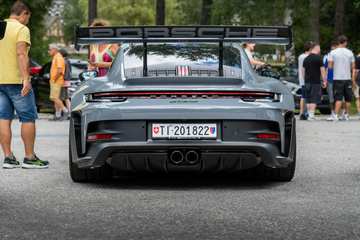 The Rimac Nevera has unequivocally established itself as the king of electric hypercars. It’s not just one of the fastest cars on this list; it’s a revolutionary machine that signals the imminent dominance of electric power in the realm of extreme performance. With a staggering 1,888 bhp and 2,360 Nm of torque, the Nevera rockets from 0-60 mph in a scarcely believable 1.9 seconds. Its charging capabilities are equally impressive, reaching 80% capacity in just 19 minutes, with a full charge providing a 340-mile range. The recently introduced Nevera R amplifies these already astonishing figures, boasting 2,078 bhp and a targeted top speed of 268 mph, solidifying its claim as the fastest-accelerating road car ever produced.
Bugatti Veyron – Top Speed: 268 mph
The Bugatti Veyron, even years after its debut, commands immense respect. Its original iteration, boasting nearly 1,000 bhp from a monumental 6.0-litre quad-turbo W12 engine, was revolutionary. However, Bugatti’s relentless pursuit of performance led to the Veyron Super Sport, which elevated power to 1,183 bhp. This variant’s 268 mph top speed remains a benchmark, with its sub-2.5-second 0-62 mph time a testament to its brutal acceleration, a figure that still challenges many modern electric vehicles. The Veyron Super Sport is, without question, an all-time great.
Hennessey Venom F5 – Top Speed: 271.6 mph
American performance specialist Hennessey has long been pushing the boundaries of speed, and the Venom F5 represents their most ambitious endeavor yet. Building upon the legacy of its predecessor, the F5, powered by a colossal 1,817 bhp twin-turbo V8, has already breached 270 mph in testing. Hennessey’s ultimate aim is to surpass the 311 mph mark, a target that, given the car’s immense power and aerodynamic focus, appears well within reach. While its rear-wheel-drive configuration presents traction challenges for its initial acceleration, its ability to reach 249 mph in a mere 15.5 seconds showcases its phenomenal straight-line capability.
Bugatti Tourbillon (Estimated) – Top Speed: 277 mph (est.)
The next chapter in Bugatti’s storied legacy is the Tourbillon, a hybrid hypercar that promises to continue the marque’s tradition of automotive excellence. Expected to launch in 2026, this machine will reportedly integrate a potent 986 bhp V16 engine with electric motors, culminating in an awe-inspiring total output of over 1,770 bhp. Given Bugatti’s unparalleled experience in crafting the fastest cars in the world, and the formidable engineering expertise they command, the Tourbillon is confidently anticipated to secure a prominent position among the elite on this list.
Koenigsegg Agera RS – Top Speed: 277.87 mph
In 2017, Koenigsegg shattered speed records once again with the Agera RS. On a closed 11-mile stretch of Nevada highway, a customer-owned Agera RS achieved a blistering 277.87 mph, setting a new benchmark for speed on public roads. This achievement further solidified Koenigsegg’s reputation as a powerhouse in the hypercar arena, demonstrating their commitment to pushing the absolute limits of automotive performance and precision engineering.
Bugatti Mistral – Top Speed: 282.05 mph
Bugatti, a brand synonymous with automotive excellence for over a century, continues to innovate and captivate. The Mistral, a stunningly expensive and incredibly rare convertible, represents the pinnacle of open-top automotive performance. Limited to just 99 units, it reached an astonishing 282.05 mph at a test facility in Papenburg, Germany, with legendary test driver Andy Wallace at the helm. Powering this exquisite machine is Bugatti’s iconic quad-turbocharged 8.0-liter W16 engine, a powerplant soon to be succeeded by the V16 in the upcoming Tourbillon.
SSC Tuatara – Top Speed: 282.9 mph
The pursuit of speed records is often fraught with challenges, and the SSC Tuatara’s journey to this list was no exception. Initial claims of a 316 mph run were met with scrutiny, leading SSC to conduct a more rigorously verified attempt. In 2021, with precise timing equipment and independent witnesses, the Tuatara achieved a two-way average speed of 282.9 mph. This figure, while not breaking the 300 mph barrier, is an extraordinary testament to its capabilities. Powered by a 5.9-liter V8 engine producing 1,750 bhp, its rear-wheel-drive configuration and lightweight carbon fiber construction contribute to its remarkable performance.
Bugatti Chiron Super Sport 300+ – Top Speed: 304.8 mph
Bugatti’s identity has become inextricably linked with the concept of extreme speed and power. The Chiron Super Sport 300+, a culmination of years of research and development, represents the zenith of this pursuit, famously breaching the seemingly insurmountable 300 mph barrier. Achieved with an enhanced 8.0-liter W16 engine producing 1,578 bhp, coupled with significant aerodynamic modifications including an extended rear end, this hypercar hit a verified 304.774 mph on Germany’s Ehra-Lessien test track. Only 30 examples were produced, making it an exclusive masterpiece for discerning collectors.
Koenigsegg Jesko Absolut – Targeted Top Speed: 310 mph
Christian von Koenigsegg’s declaration of creating “the absolute fastest Koenigsegg we will ever make” was a statement that sent ripples through the automotive world. The Jesko Absolut, a low-drag variant of the already potent Jesko, is the embodiment of this ambition. Engineers have meticulously refined its aerodynamics, including an extended body and the removal of the rear wing, while simultaneously optimizing its power output to a formidable 1,600 bhp from its twin-turbocharged V8. While official figures are still pending, Koenigsegg’s target of 310 mph is a serious aspiration, especially given their proven track record in setting and breaking speed records. The rivalry with Bugatti for the ultimate top speed crown remains a thrilling narrative.
Yangwang U9 Xtreme – Top Speed: 308 mph
The rise of electric vehicles has undeniably disrupted the hypercar hierarchy. The Yangwang U9 Xtreme is a prime example, a vehicle that shatters preconceived notions by achieving an astonishing 308 mph, a speed that eclipses many of the most expensive gasoline-powered hypercars, all at a price point significantly below the million-dollar mark. This remarkable feat is attributed to a combination of aerodynamic enhancements, four ultra-powerful electric motors delivering a combined 2,978 bhp, and an advanced 1,200V architecture for superior power transfer. Developed by BYD, the U9 Xtreme represents a paradigm shift, demonstrating that the future of extreme automotive performance is electrifying.
This journey through the fastest cars in the world for 2026 reveals a landscape in constant flux, driven by relentless innovation and an enduring passion for speed. Whether you’re captivated by the raw power of internal combustion or the silent, surging force of electric propulsion, the automotive industry continues to deliver astonishing machines that redefine the very concept of velocity.
As we look ahead, the pursuit of high-performance vehicles and luxury car sales remains a vibrant sector. The technological leaps we’ve witnessed, particularly in electrification, promise even more exhilarating developments in the coming years. Whether you dream of owning one of these incredible machines or simply wish to stay informed about the cutting edge of automotive engineering, the world of supercars and hypercars offers an endless source of fascination.
The Rimac Nevera has unequivocally established itself as the king of electric hypercars. It’s not just one of the fastest cars on this list; it’s a revolutionary machine that signals the imminent dominance of electric power in the realm of extreme performance. With a staggering 1,888 bhp and 2,360 Nm of torque, the Nevera rockets from 0-60 mph in a scarcely believable 1.9 seconds. Its charging capabilities are equally impressive, reaching 80% capacity in just 19 minutes, with a full charge providing a 340-mile range. The recently introduced Nevera R amplifies these already astonishing figures, boasting 2,078 bhp and a targeted top speed of 268 mph, solidifying its claim as the fastest-accelerating road car ever produced.
Bugatti Veyron – Top Speed: 268 mph
The Bugatti Veyron, even years after its debut, commands immense respect. Its original iteration, boasting nearly 1,000 bhp from a monumental 6.0-litre quad-turbo W12 engine, was revolutionary. However, Bugatti’s relentless pursuit of performance led to the Veyron Super Sport, which elevated power to 1,183 bhp. This variant’s 268 mph top speed remains a benchmark, with its sub-2.5-second 0-62 mph time a testament to its brutal acceleration, a figure that still challenges many modern electric vehicles. The Veyron Super Sport is, without question, an all-time great.
Hennessey Venom F5 – Top Speed: 271.6 mph
American performance specialist Hennessey has long been pushing the boundaries of speed, and the Venom F5 represents their most ambitious endeavor yet. Building upon the legacy of its predecessor, the F5, powered by a colossal 1,817 bhp twin-turbo V8, has already breached 270 mph in testing. Hennessey’s ultimate aim is to surpass the 311 mph mark, a target that, given the car’s immense power and aerodynamic focus, appears well within reach. While its rear-wheel-drive configuration presents traction challenges for its initial acceleration, its ability to reach 249 mph in a mere 15.5 seconds showcases its phenomenal straight-line capability.
Bugatti Tourbillon (Estimated) – Top Speed: 277 mph (est.)
The next chapter in Bugatti’s storied legacy is the Tourbillon, a hybrid hypercar that promises to continue the marque’s tradition of automotive excellence. Expected to launch in 2026, this machine will reportedly integrate a potent 986 bhp V16 engine with electric motors, culminating in an awe-inspiring total output of over 1,770 bhp. Given Bugatti’s unparalleled experience in crafting the fastest cars in the world, and the formidable engineering expertise they command, the Tourbillon is confidently anticipated to secure a prominent position among the elite on this list.
Koenigsegg Agera RS – Top Speed: 277.87 mph
In 2017, Koenigsegg shattered speed records once again with the Agera RS. On a closed 11-mile stretch of Nevada highway, a customer-owned Agera RS achieved a blistering 277.87 mph, setting a new benchmark for speed on public roads. This achievement further solidified Koenigsegg’s reputation as a powerhouse in the hypercar arena, demonstrating their commitment to pushing the absolute limits of automotive performance and precision engineering.
Bugatti Mistral – Top Speed: 282.05 mph
Bugatti, a brand synonymous with automotive excellence for over a century, continues to innovate and captivate. The Mistral, a stunningly expensive and incredibly rare convertible, represents the pinnacle of open-top automotive performance. Limited to just 99 units, it reached an astonishing 282.05 mph at a test facility in Papenburg, Germany, with legendary test driver Andy Wallace at the helm. Powering this exquisite machine is Bugatti’s iconic quad-turbocharged 8.0-liter W16 engine, a powerplant soon to be succeeded by the V16 in the upcoming Tourbillon.
SSC Tuatara – Top Speed: 282.9 mph
The pursuit of speed records is often fraught with challenges, and the SSC Tuatara’s journey to this list was no exception. Initial claims of a 316 mph run were met with scrutiny, leading SSC to conduct a more rigorously verified attempt. In 2021, with precise timing equipment and independent witnesses, the Tuatara achieved a two-way average speed of 282.9 mph. This figure, while not breaking the 300 mph barrier, is an extraordinary testament to its capabilities. Powered by a 5.9-liter V8 engine producing 1,750 bhp, its rear-wheel-drive configuration and lightweight carbon fiber construction contribute to its remarkable performance.
Bugatti Chiron Super Sport 300+ – Top Speed: 304.8 mph
Bugatti’s identity has become inextricably linked with the concept of extreme speed and power. The Chiron Super Sport 300+, a culmination of years of research and development, represents the zenith of this pursuit, famously breaching the seemingly insurmountable 300 mph barrier. Achieved with an enhanced 8.0-liter W16 engine producing 1,578 bhp, coupled with significant aerodynamic modifications including an extended rear end, this hypercar hit a verified 304.774 mph on Germany’s Ehra-Lessien test track. Only 30 examples were produced, making it an exclusive masterpiece for discerning collectors.
Koenigsegg Jesko Absolut – Targeted Top Speed: 310 mph
Christian von Koenigsegg’s declaration of creating “the absolute fastest Koenigsegg we will ever make” was a statement that sent ripples through the automotive world. The Jesko Absolut, a low-drag variant of the already potent Jesko, is the embodiment of this ambition. Engineers have meticulously refined its aerodynamics, including an extended body and the removal of the rear wing, while simultaneously optimizing its power output to a formidable 1,600 bhp from its twin-turbocharged V8. While official figures are still pending, Koenigsegg’s target of 310 mph is a serious aspiration, especially given their proven track record in setting and breaking speed records. The rivalry with Bugatti for the ultimate top speed crown remains a thrilling narrative.
Yangwang U9 Xtreme – Top Speed: 308 mph
The rise of electric vehicles has undeniably disrupted the hypercar hierarchy. The Yangwang U9 Xtreme is a prime example, a vehicle that shatters preconceived notions by achieving an astonishing 308 mph, a speed that eclipses many of the most expensive gasoline-powered hypercars, all at a price point significantly below the million-dollar mark. This remarkable feat is attributed to a combination of aerodynamic enhancements, four ultra-powerful electric motors delivering a combined 2,978 bhp, and an advanced 1,200V architecture for superior power transfer. Developed by BYD, the U9 Xtreme represents a paradigm shift, demonstrating that the future of extreme automotive performance is electrifying.
This journey through the fastest cars in the world for 2026 reveals a landscape in constant flux, driven by relentless innovation and an enduring passion for speed. Whether you’re captivated by the raw power of internal combustion or the silent, surging force of electric propulsion, the automotive industry continues to deliver astonishing machines that redefine the very concept of velocity.
As we look ahead, the pursuit of high-performance vehicles and luxury car sales remains a vibrant sector. The technological leaps we’ve witnessed, particularly in electrification, promise even more exhilarating developments in the coming years. Whether you dream of owning one of these incredible machines or simply wish to stay informed about the cutting edge of automotive engineering, the world of supercars and hypercars offers an endless source of fascination.
 Ready to explore the future of automotive performance or find the ultimate driving experience? Contact us today to discuss your interests in the world of high-speed, luxury, and cutting-edge automotive technology.